Saturday, 30 August 2014

ROSE LANE CONVICT CEMETERY, GLEN DHU

SIGN ON WESTBURY RD
Around 2010-2011 there seemed to be a great deal of activity around the convict cemetery in Rose Lane, South Launceston. The National Trust was involved, children from Glen Dhu school made commemorative tiles (unfortunately some are already worn and broken) and a small sign was placed on Westbury Road. I'm having some difficulty finding out what has happened since.

There may be more burials there than the size of the cemetery, which existed as such between 1846 and 1874, might suggest, as it has been claimed that bodies were interred 5 or 6 deep at each gravesite, and that Rose Lane may be the final resting place for around 320 people.

Memorial Tiles
I'd venture to suggest that most people who live in Launceston remain unaware of the cemetery's existence, and in honesty there's not much to see, if “seeing” rather than “being” is your thing. There is a low walled circle of stones, and some arrows marked on the ground, but there is no sign at the actual entrance, nor anything to say what the arrows mean, and no information about the overall significance of the burial ground. The children's tiles record the names, and other information about some of the people known to be buried there. It is tremendously sad to think that having survived a long and dangerous sea voyage, they died alone in a strange and distant land, away from families and friends.


SITE OF ROSE LANE CONVICT CEMETERY

Saturday, 23 August 2014

34 BOURKE STREET - Electricity and Explosives

OLD POWDER MAGAZINE SITE AND ELECTRICITY DISTRIBUTION STATION
There are two ways of going about this blog. One is the sensible way, which is to find out a great deal of existing interesting information about a building and then take a picture of it, and the other way, which is to wander past and, think “Oh this looks interesting,” take a picture and then try to find out what it is and how it came to be. As you have probably gathered by now, my posts generally fall into the latter category.
This week's building is a case in point. We were walking down Margaret Street, and decided to wander up Canning Street. Just around the corner in Bourke Street was an unusual brick building set in a long empty block. I guessed “church”, but I was wrong. The QVMAG's indispensable paper on Launceston's Industrial Heritage tells us that it was, in fact an electricity distribution station, designed by C. St John David, and built by J&T Gunn in 1894. It also mentions that it once had a tower which has since been removed.A newspaper report from 1940 talks of the construction of a new sub-station in Bourke Street but doesn't give any more details so I'm not sure what relationship (if any) it has to this building. It is now on the Heritage Register as “a house” so presumably some redevelopment has been undertaken.
The building is described in the Heritage Council Annual Report of 2009-10 as “Powder Magazine Site and Former Electricity Distributing Station.” was one of 58 additions to the permanent Heritage Register in that year. Gunpowder and other explosives were usually stored in government-owned facilities away from houses for obvious reasons. Presumably the expanding town necessitated the move. Even in the 1850s, there were issues with the location of the magazine. The Examiner of 12 March 1858 referred to “that dangerous old magazine on Cateract Hill.” The newspapers of the time were full of reports of powder magazines exploding at various locations within Australia and elsewhere, so obviously no one was keen to have one on their doorstep.
The original powder magazine was closed in the 1870s, and moved to a location in Henry Street. (More information about the new storage site can be found at


I'm aware that this is a bit disjointed and am very conscious that there is more to be told – once again I can either not post this because I'm not happy with it or go with it in the hope that someone who can fill in more information about this building's history might like to comment. I'm also having a bit of trouble finding the newer powder magazine site....I suspect I've seen it but not recognised it for what it is.....any suggestions?

Sunday, 17 August 2014

251 INVERMAY ROAD - ST FINN BARRS

ST FINN BARRS INVERMAY
The original St Finn Barr's school, established by the Presentation Sisters in 1893 was at the corner of Forster and Holbrook Street, Invermay. It was destroyed by a fire which occurred shortly before 2 am on 25th March 1925. The blaze was so intense, that according to newspaper accounts of the time “every house on Trevallyn stood out as if in daytime.” This was just one of many unexplained fires that occurred around this time, including several houses and a furniture factory. Some 15 months after the St Finn Barr's fire, the drill hall being leased as a temporary replacement, was damaged by another blaze. The Examiner reported that local residents feared a “fire maniac” was at large.

Funds were quickly raised for the new school, at 247 - 251 Invermay Road, which was consecrated by Bishop Dr W Barry in May 1927. The building, described by the Examiner as “Romanesque”, and by the National Heritage data base as “Inter War Free Classical Style” cost 7 000. Speakers complained “bitterly” that despite not making any contribution to the building, the land upon which the school was built was to be taxed by the state government “so that the mud could be taken out of the Tamar.” The architect was “Mr Tandy” and the builders “Messrs Munro and Quinn.”

The Presentation Sisters continued to be involved in the operation of the school until 1993.

(A very readable account of the history of The Presentation Sisters in Australia can be found at http://presentationsociety.org.au/about/our-history/ - its worth noting that this article mentions that the first school established by the order in the southern hemisphere was in Richmond, Tasmania in 1866.)


Additional details (particularly in relation to the building's architecture), as well as a more conventional photo can be found at http://www.environment.gov.au/cgi-bin/ahdb/search.pl?mode=place_detail;place_id=100199.   

Saturday, 9 August 2014

60 WILLIAM STREET - GLASGOW ENGINEERING

GLASGOW ENGINEERING - 60 WILLIAM STREET
Glasgow Engineering is one of the longest operating engineering firms in Australia. Originally called Tamar Foundry, it has been operating in William Street since 1892, although the facade we see today is believed to date from around 1900. The company, which has played a fascinating role in the industrial heritage of Launceston has a well written history on its website, including photographs, so if you would like to know more, go to http://www.glasgowengineering.com.au/ and look under “Company Profile.”

Check out the photo of a bullock team and steam engine towing a boiler made by the foundry at the State Library: http://catalogue.statelibrary.tas.gov.au/item/?q=launceston&avail=Online&format=Images+%5c+Photograph&i=78&id=LPIC147-1-380#urls

Saturday, 2 August 2014

CLARENDON

CLARENDON

Clarendon was built by grazier and politician James Cox in 1838, and is one of the best known of the Tasmanian National Trust Properties. The folks who maintain the building and grounds have done a terrific job but clearly need more finances, especially to fix a leaky roof! If you haven't been, I'd recommend a visit, although be aware that according to the Trust's website the house is closed in July and August. Clarendon is an easy 27km drive from Launceston, (well this blog is called Look Around Launceston) and if you go on a Sunday you can always stop at Evandale for the market and morning tea.

There is so much information available about James Cox and indeed Clarendon and I don't have any great new insights to add, so.......if you'd like to know more see:
http://adb.anu.edu.au/biography/cox-james-1931 (Australian Dictionary of Biography)
or just Google “James Cox Clarendon”.

As there are many photos of the front of the house already on-line, the one you see here is of the back!!

Saturday, 26 July 2014

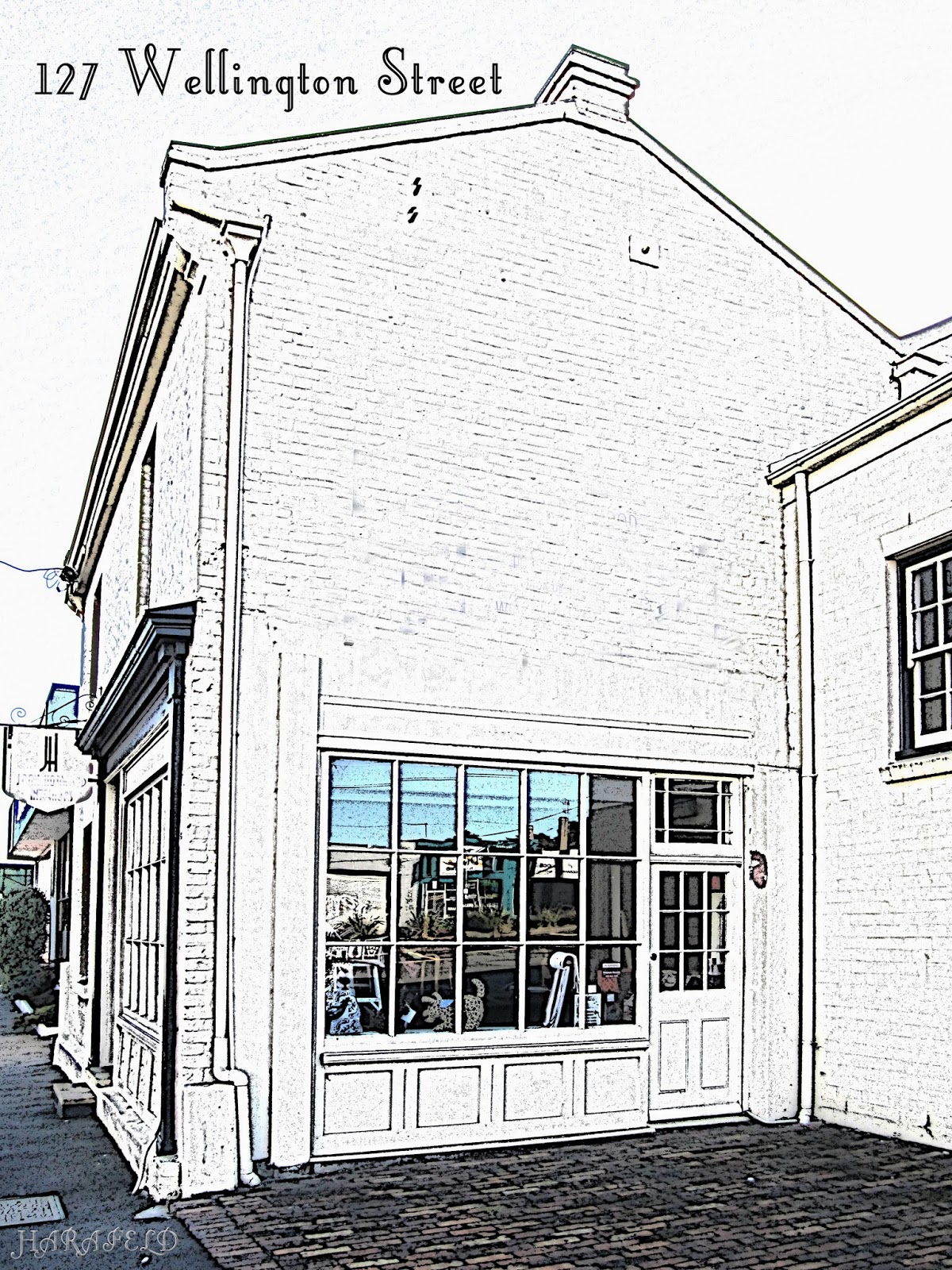
127 WELLINGTON STREET

 127 Wellington Street has never drawn my attention before, although I must have driven past it thousands of times. It was only when I walked by, for the first time, that I noticed some rather attractive “doodaderry” (as pictured) and decided to find out more.

This little building, which today houses an interior design business, has been on the heritage register of the national estate since 1978. According to the Heritage Database Site, it was constructed in the 1840s as a house, and had a shopfront added at a later date, along with various other modifications.

The first reference I could find in the newspapers (via TROVE) was 1894, when James Thomas, of this address was accused of stealing some chooks and a couple of stringy bark posts from his neighbour. The same year an advertisement was place seeking “a young lady to teach sewing,”but the nineteenth century otherwise remains a bit of a mystery. It is not surprising, as street numbers were not usually given until around 1892.

The property has a number of mentions in twentieth century newspapers, the saddest being a report about little Francis McCullagh who died in 1927 when the woodpile he was playing on, collapsed.

I don't know when the shop was added to the main building, but it existed in 1928 when the premises what known as “ The Leading Butchery.” In 1903, someone from this address advertised for the return of a lost sheep and lamb, so probably it was a butchery then too.

In 1930, two youths responsible for a series of robberies in Launceston, were recaptured at this location, the home of Elizabeth Jordan, after they had escaped from the lock-up. The youth's crime spree is recounted in The Mercury of 25 October The two young men claimed that they were encouraged in their endeavours by Elizabeth.

The building underwent a change of usage when 1937 Walter Gillam opened a home for old men at 127 Wellington Street.

In 1976, the building became the Commercial Traveller's Club. The club closed in 1988.(For more information about the Commercial Traveller's Association see http://www.qvmag.tas.gov.au/upfiles/qvmag/imglib/collections/CHS56%20Commercial%20Travellers'%20Association%20of%20Tasmania%20(CTA).pdf ).

127 Welllington Street has since been occupied by an electrical repair shop, and as mentioned at the beginning, an interior designer.

There are clearly many missing details in this account. A peek in Post Office Directories, phone books and so on would no doubt fill in many of the gaps. I haven't done this as....well.... to be honest, I'm not really that interested (I will no doubt soon find out that I've missed some truly earth-shattering historic event which occurred on the premises because I didn't bother to find out more!). Hopefully the information I have included gives some insight into how a single building can have many uses over time and illustrates that each of Launceston's “less grand” older city buildings can provide an insight into the story of small business that is often overlooked, but which is a vital part of the commercial history of Launceston.


Saturday, 19 July 2014

217B INVERMAY ROAD, THE STAR THEATRE

THE STAR THEATRE, INVERMAY ROAD
And yes.....I do requests.......When I asked Marvin (my husband, and not his real name) which building he thought I should look at next, he nominated the Star Theatre without hesitation. This lovely building is in a highly visible spot on a major road, and yet is easy to simply drive past without fully appreciating its beauty.

According to a report in The Examiner , when the theatre opened in Invermay on October 05th 1937, hundreds gathered outside to admire the neon lighting. It was also truly impressive inside. (Take a look at the description in The Examiner of 01 October 1937 via TROVE!) There were 250 velvet upholstered lounge chairs in “the circle” and 650 rubber cushioned seats in the stalls, and the lighting was provided by amber globes.

The Star was Launceston's first suburban theatre. Guy Crick (from Sydney) was the architect (“in association with Mr A Harold Masters of Launceston”), but the building work was undertaken by local firm J and T Gunn. The design is “a mixture of interwar functionalist and art deco style”...and if you want to know what that means, consult the building's description on the Australian Heritage database

Alderman Hollingsworth undertook the ceremonial opening, saying that “the management had assured him that a very careful watch would be kept, and that nothing harmful to the youth of the district would be screened.” We are left to ponder what would have been deemed “harmful” but evidently the opening films Roberta (with Fred Astaire and Ginger Rogers) and The Plot Thickens were judged to be acceptable.

The theatre had a revolving star, which was turned on at 7 o'clock each night, and people would dress in their Sunday best, and book regular seats. The demise of the theatre was attributed to competition from television and the drive-in. (Examiner 27th July 1999)

The theatre closed on July 26th 1969. The last movie shown was The Green Berets. The building was purchased by the St Vincent de Paul Society in 1971, and is still occupied by them today.


Saturday, 12 July 2014

CORNER OF WELLINGTON STREET AND YORK STREET

CORNER OF WELLINGTON AND YORK STREET
A visitor to Launceston asked whether or not the Jailhouse Grill was ever a jail. “Oh no”, I replied, then “well.......I don't think so......actually I'll find out!”

My first instincts were right – the Grill's own website helpfully provided the information that in was built as a pub, The Prince of Wales, in the mid 1800s, from bricks made locally by convicts, and had subsequently operated as such albeit under other names – The Richmond Hotel, Barnaby's Hotel and the Ball and Chain Grill. (www.jailhousegrill.com.au/about.htm).

Its a little confusing tracking the building via early newspapers as there was a second “Prince of Wales” at Evandale, and its not always clear to which establishment articles refer. There also seems to have been another hotel called the Dolphin, located on the corner of Wellington and York Streets during the 1840s. It is also worth mentioning that the building formerly known as the Courthouse Hotel, also in Wellington Street, did have a police lock-up attached....but that's a story for another week.

It seems that John Hinshaw in September 1843 transferred his licence from The Kangaroo Inn to the Prince of Wales. When the licence was reviewed in 1847, the premises was found to be clean and respectable, and there had been no convictions, however....the committee heard that the police constable had found the landlord seemingly drunk when the inspection took place. Hinshaw explained that he was simply responding to a joke, (sadly we'll never know the details) and the licence was duly granted. (Examiner 04 September 1847).


The hotel was still known as the Prince of Wales in 1940, (when a pint of Kentdale lager “straight from Melbourne” could be had for 1/1 a bottle), and I despite spending an evening on-line and emptying my bookshelves (well...not quite..but still....) I haven't found any information about how the building was used after that time. Perhaps someone could help provide extra details?

Saturday, 5 July 2014

114-116 CAMERON STREET - STRUAN AND SUPREME COURT BUILDING

114-116 CAMERON STREET - STRUAN AND SUPREME COURT BUILDING
Struan was built by James Robertson in 1870, at a cost of around six thousand pounds. It incorporated many “features” worthy of comment at the time including hot water, piped up from the kitchen stove to the upstairs bedrooms. The architect was Peter Mills, and the builder E. Ford.

Aspects of Robertson's life reads like a story from a Victorian Boy's Own Annual with tragedy (a brother who drowned in the South Esk), adventure (a memorable encounter with a dangerous bushranger), mercantile success (as evidenced by the bricks and mortar of Struan), and more! According to his obituary, published in The Cornwall Chronicle of 03 April 1874 (which can be read on Trove), he resisted much encouragement to enter formal politics, but was still greatly involved in community pursuits. He was, for instance, among many other things, captain and paymaster of the Voluntary Artillary Corps. According to Beverley Heathcote in her book A Walk Through Launceston's History, John Robertson was “well-known....for driving around the town in his open carriage flanked by his two dalmatian dogs.”

When Robertson died in 1874, central Launceston paused – most of the city's civic leaders attended the funeral, and shops were closed along the route between Struan and the Scotch Cemetery, which was located in High Street. Mrs. Robertson died in 1891.

In 1891, Struan was used as a residence for the Governor during the Tasmanian Exhibition. Bennell Brothers did the necessary refurbishment. At that time The Examiner (14 October) stated that the grounds contained “two of the finest magnolia trees in Tasmania.” I suspect they are no longer there, but I will look next time I'm passing! Dr. Pike, (who died in 1912), followed by Sister Massey had the house after this time, the latter operating it as a hospital until August 1919.

In 1920, Struan was purchased for 7,000 pounds by Dr. Arthur E. Panting from Zeehan who re opened it as a private hospital, which it remained until 1927. At that time there was a proposal to us it as a maternity hospital, but sufficient funds could not be raised and it was decided, in 1928, to consider making it the site of the new Supreme Court instead. At that time the house was located on over an acre of land. Work began on 01 July 1929. S.R. Featherstone was the contractor. The law offices of the new courthouse were located in Struen House. At the time of its official opening, the new building works had cost 9,000 pounds, with plans for additional development.

In 1929 Struan played a unique role after the disastrous floods of that year. The Examiner of May 03 reported: “It is almost unbelievable that during the couple of weeks Struan central sewing depot (in charge of the Australian -Women's National League) has been in existence over 1200 garments
have been issued for the relief of those who suffered through the flood. The official record kept by the secretary of the league shows that to date 776 new garments have been cut out and distributed to work parties, while 600 second-hand garments have been remade.”

It goes without saying that there are many stories from the Supreme court from after 1930 that could be told.

There are a lot of photos available on-line, of Struan in past times One example can be found at: http://catalogue.statelibrary.tas.gov.au/item/?id=PH30-1-5027#urls.
I was tempted to remove the phone box from the photo but it occurred to me that in twenty years or so (probably less) this will, in itself be “of historic interest!” Be aware that it is the back of Struan that “fronts” Cameron Street. Not surprisingly the house was built with an outlook to the river.

Saturday, 28 June 2014

CORNER CHARLES AND PATERSON STREETS - THE NATIONAL THEATRE

THE NATIONAL THEATRE, CNR. CHARLES AND PATERSON STREETS
The National Theatre remains an impressive building on the corner of Charles and Paterson Street. It was designed by Thomas Searell, and built by Harry Goodluck. The Launceston City Council sold the building to the printing firm that still occupies it, in 1969.

The first performance at the theatre, when in opened in September 1915 was “The Silence fo Dean Maitland by Mr George Marlow's Dramatic company. The programme in the early days of the theatre were nothing if not eclectic, as a quick look at early Examiners (via TROVE) illustrates:

05 March 1918: Film - “Unborn” - dealing with the nation's decreasing birthrate “in a manner that gives no offence”
27 March 1918: “Mr. J. D. Foley, comedian and ventriloquist, will appear after an absence of five years. In the afternoon Mr. White will show Punch and Judy for the little ones.”
07 June 1918: The Launceston season of the high class vaudeville combination at the National Theatre is drawing to a close The farces, introducing the full strength of the company, are amongst the most humourous items of their kind offered,and the individual contributions by Doody and Wright, music and dancing artists; Lennon and Hill. society entertainers; Dozey and Doura, acrobats and balancers; Fred. Arthur comedian, Arthur Sharples, tenor vocalist, Laura McLaine, soprano; and Violet Lorraine,soubrette; constitute a programme of rare merit.”........and so on

These are three fairly random samples from just one year – there is a lot more packed into the 44 years of the theatre's operation and each of the performances and events has a whole history worthy of further investigation.


Saturday, 21 June 2014

68 PATERSON STREET - PAINE'S CARRIAGE WORKS

PAINE'S CARRIAGE WORKS
Paine's Carriage Works were established in Launceston by George Paine who emigrated from England in 1860. The original works were at 192 York Street (with showrooms in Wellington Street), but moved to Paterson Street in 1902, by which time George's son Frederick was in charge.  The construction of the new building was overseen by architect Edwin Laidlaw.  Paines built the first brougham and hansom cabs in Launceston and won many prizes.


The business made the transition from horse-drawn vehicles to the motor car. An article in the Examiner (08th October 1914) comments that Mr Paine had already had twelve years experience in this area! Paines built a bus to service areas where the tram didn't go, and made the first two seater car built in Northern Tasmania, as well as an ambulance and fire engines.

Their cars sound like quite something to see. The same article says: “Two of the latest five-seated bodies ... are painted blue, picked out black, with a fine gold line, which harmonises with blue leather trimmings. The vehicle is mounted on a 15-20 Fiat chassis, supplied by the Fordyce Motor Company, and is indeed worthy of inspection.”

But if the cars were impressive, their bus promised to be a marvel. Here is the description published in The Examiner of 25th August 1905: “The car is built of English ash and cedar, varnished, and both woods can be distinguished as one enters. The long cedar panels are beautifully let into solid pilars, and the platform on which the conductor stands to receive passengers and parcels is shut off from the car when necessary by a sliding door. The seats are spring cushions of the most modern design, covered in moss-green Russian leather. On the outside the car panels are painted in pretty green, picked out in black, and lined with orange. In front of the ladies' car is a smoking compartment, which has seating and accommodation for eight passengers. It may be closed right off from the hind car by glass windows. Those on board can see all round, as the windows facing the driver's box are circular in shape. One of the improvements is the attachment of two nickel handles to hold as one enters either compartment., The driver's box is fitted up with a tool cabinet of polished wood. There are 34 windows in cedar frames,so there is no lack of ventilation, and every window has a spring catch, which works automatically. When necessary, the curtains, which are fixed to every window on brass rollers, may be let down. The nickel-plated funnel and brass ventilator in front sets off the appearance of the 'bus greatly. The whole of the work, with 'the exception of the undercarriage, is being carried out at .Mr. Paine's factory, and when completed it will reflect great credit upon the designer and builder.”

The firm seems to have been very innovative. If no one has done it already there is a local history book waiting to be written here!!!!! A search on TROVE will turn up many other fascinating snippets of information. The Examiner of Friday 7 June 1895 has an interesting article about the carriageworks. You can see some photos of buses at http://nonsequitur.freeforums.org/lkcs-lesser-known-coachbuilders-t58-90.html and of their two-seater car at http://catalogue.statelibrary.tas.gov.au/item/q=paine&format=Images&avail=Online&i=3&id=LPIC147-1-65#urls.

Interviews with Fred James and Rex Case who worked for Paines in the early 1920s can be found in Launceston Talks - Oral Histories of the Launceston Community.


Sunday, 15 June 2014

1 CIVIC SQUARE - HENTY HOUSE

1 CIVIC SQUARE - HENTY HOUSE
This is the building many people love to hate. Leo Shofield referred to it as "a hideous building resembling a cement cooling tower".  At risk of being labelled one of the “trendoids” to whom he refers, I have to confess as a Launceston resident, I'm actually rather fond of it.

I vaguely remember (showing my age here) seeing drawings before it was built projecting what it would look like when finished. Every level had green vines trailing down over the balconies – an amazing pyramid of greenery. It has, of course, instead turned out to be a huge grey monolith that dominates the edge of Civic square. The “wood” texture of on some of its surfaces only seems to emphasise its inorganic character. Yet, there is nothing else quite like it.

Civic square is a wonderful architectural assortment that is nicely rounded off by Henty House. I like the way that Macquarie House reflects in the windows of the newer structure, and the fact that every time I walk past I see something else that I haven't noticed before. I love that it makes people think and talk about how they want their city to look.


Henty House was built for its current tenant, the State Government in 1983. The architect was Peter Partridge. People have been married here, become Australian citizens here, celebrated passing their driving test and so on. It is a building of many stories.  There has been considerable debate over whether it is worthy of inclusion in the state heritage list. This blog is mainly about the history associated with various buildings rather than the structures as such, but if anything were to happen to Henty House there would be a large gap in the story of Launceston in the 1980s. Its worth considering the question of what makes a building worthy of preservation.