Showing posts with label Wellington Street. Show all posts

Saturday, 16 December 2017

WELLINGTON STREET 155-175M Dunorlan Terrace


Dunorlan Terrace, in Wellington Street was built as part of an early affordable housing scheme initiated by Henry Reed, and completed after his death.

According to the Australian Heritage Places Inventory, the building is of Italianate style, described thus: “This is a group of three terrace buildings with a hipped roof and dividing parapet walls with shared chimneys. The original verandah has been removed and replaced with a concrete walkway and steel railing. The first floor windows have segmental arched heads with a rendered voussior stone. Each terrace consists of a side hall and is a single room wide and two rooms deep”.

This particular terrace was designed with the “artesan class” in mind. At the end of May 1884, The Tasmanian reported that all but the middle residences of the eventual 14 5-roomed houses had been completed and let to “respectable tenants” at a “moderate rental.” Competition was said to be fierce.


If you look at the sold properties of local real estate agents you can see what some of them look like inside today.

Saturday, 18 November 2017

WELLINGTON STREET

WELLINGTON STREET, LOOKING SOUTH
Wellington Street has been a main thoroughfare in Launceston since its earliest days.

It was one of the original fourteen streets of Launceston officially named by Lt Governor Arthur in January 1825.

The others were:  Bathurst, Charles, Elizabeth, Brisbane, Frederick, George, Cameron, Tamar, William, York, Cimitiere and Paterson.  The fourteenth street was recorded in the Tasmanian and Port Dalrymple Advertiser of 26th January 1825 as St John's Street.  Today we seem to have done away with the 's and it is simply referred to as St John Steet.

Tuesday, 15 November 2016

136 WELLINGTON STREET

BRITANNIA HOUSE, 136 WELLINGTON STREET
This building is described by the Tasmanian Heritage Council as “A two storey Georgian building with ordered fenestration, a hipped roof, narrow boxed eaves and an articulated corner.” For those who are wondering I'll save you the trouble of looking up “fenestration” which seems to just mean “windows.

There are a lot of comparatively recent additions to the basic structure so its easy to drive by and not appreciate the rather nice structure underneath (rusty roof and all). The Heritage Council's data sheet records the building at 136 Wellington Street as originally being the “Britannic Hotel.” There are several references in early newspapers to the Britannia in Wellington Street, but none that I can find to the Britannic Hotel............so maybe a typo?

The earliest reference I found to an establishment by the former name was an inquest held on the premises in February 1839. In 1840 it is referred to as “Britannia Inn,” in 1843 it was the “Britannia Tavern”. Later that decade it is referred to as “The Britannia Wine Vaults” and later still as the “Britannia Wine Cellar.” Patrick Monaghan was the licensee in 1845. Unfortunately beyond “Wellington Street” there is little indication of precisely where the hotel(s) was/were located.

This extract from the Launceston Family Album (a record of those who attended the Tasmanian Exhibition” of 1891-92) provides some helpful clues: 

“Gertrude Elizabeth Doolan was born in Launceston on 20 May 1868, the fourth child of Thomas Joseph Doolan and his wife Jane Monaghan (died Oct 1920). Gertrude was believed to have stayed at home as housekeeper to her mother and brothers following the death of her father in Dec 1885. She lived out her life at 'Brittania House', which was formerly the Brittania Wine Vaults, with her two brothers Gervase and Arthur. The building was later to become the funeral parlour of the Doolan family”. -Margaret Brown & Janice Fletcher Oct 2005


A quick search confirmed that the location of Doolan's funeral parlour was, indeed, located at 136 Wellington Street.  For the blog photo, 

I photoshopped out an inconveniently located telegraph pole, but there was nothing I could do about the “modern” extensions and all the signage. When you next drive by, though, it's worth looking beyond the obvious exterior to the rather nice nineteenth century building hiding underneath.

Thursday, 18 June 2015

PIZZA PUB - CNR WELLINGTON AND FREDERICK STREETS

This hotel,as a building, is often overlooked, I suspect because it fronts onto Wellington Street (this view is of the Frederick Street side) and is somewhat overloaded with poles and wires, lights and signs, which draw attention away from the building itself.  (As seen in the smaller unedited picture.

The Pizza Pub has a much richer heritage than its current name would suggest, as it is in fact one of the oldest buildings in Launceston.  

THE ELEPHANT AND CASTLE, ORIENT HOTEL AND PIZZA PUB
The original Elephant and Castle was first licensed in September 1830, to John Connolly, who was also the owner. The report in the Launceston Advertiser gives its location as “Brisbane Street.” The names of hotels did move around time from time , but as the same record incorrectly indicated that the Royal Oak (which is in Brisbane Street) was in Wellington Street, it was probably a typo. Its worth remembering that just because a contemporary source says it's so, doesn't mean its true! In any case, by the time the license passed to Thomas Kelly in 1833, the location was established as “Wellington Street”. Connolly was taken to court over outstanding debts in 1834, and was threatened with sale of the property if they remained unpaid. Kelly had his own problems – he placed an advertisement in The Advertiser in 1835 cautioning against extending credit to his wife, who had left him “without provocation.”  

As the Elephant and Castle, it was home to annual horse sales, as well as the civic functions typically held in hotels in the nineteenth century – inquests, meetings of sporting clubs and so on

In 1836 it was,for a time, renamed the Currency Lass Public House.

I'm not sure when it became The Orient but it was named thus is 1911. If you're keen you could track the licensing information printed in contemporary newspapers, and probably work it out. There was a serious fire, in which a man died in 1928. Most of the roof was destroyed and areas not damages by the flames suffered water damage.

In the 1920s, the hotel (as did many others) had difficulties with accusations of illegal trading. In 1923, for instance, it was claimed that the folk going in the doors after six were using the billiards or wireless plant, and/or attending meetings of axeman (chopping events were held in the yard of the hotel) or cyclists!! Although doubtless people attended the hotel to do all those things, the explanation seems a little dodgy, especially given that the police were clearly convinced there was a case to answer. but the license was renewed none-the-less.There were accusations of illegal bookmaking in the 1930s, and at least one brawl large enough to result in newspaper reports and formal charges, the following decade.

The hotel has been reborn in modern times as The Pizza Pub, and is part of a larger retail group.  Its founders would not have begun to understand the concept of home delivered gourmet pizzas!!  I suspect, though, that the Elephant and Castle/Currency Lass/Orient/Pizza Pub might make a good case study of how hotels have changed over time.


Saturday, 13 December 2014

GATEWAY BAPTIST CHURCH, WELLINGTON STREET

GATEWAY BAPTIST CHURCH
 After her husband's death Henry Reed's widow, Margaret built the larger church on the Wellington Street site next door to Parr's hotel, as a memorial to her husband, and to ensure his evangelical work in the community continued.

The foundation stone of the Gateway Baptist Church was laid on 20 July 1883. A bible, placed in a copper cylinder was buried underneath. The architect was Frank Tyson, and the building contractor John Todd Farmilo. Walter Hiddlestone came from Melbourne after Henry reed's death and was pastor at the time of the opening of the new church, in July 1885.

An article published in 1929, commemorating the fiftieth anniversary of the mission, claimed that prior to the first world war, as many as 1400 people attended services. Whilst such large congregations rarely assemble today, regular services are still held at the church, which continues to address the needs of the local Launceston community within a modern multicultural world, and Henry Reed's legacy remains alive.

Thanks again to Lee for the brilliant picture of the church in its early days.


HISTORIC VIEW OF WELLINGTON STREET

Saturday, 6 December 2014

THE CHRISTIAN MISSION CHURCH - 22 WELLINGTON STREET

BAPTIST CHURCH HALL, WELLINGTON STREET
Henry Reed, an early free settler, whaler, merchant and businessman, was a keen evangelist. (See the entry re: Macquarie House see last week's post) about the health of his horses and used his stables in town, however the story of how the discussion began regarding his buying his Wellington Street hotel involves one of his horses, being exercised by one of his grooms near Reed's house at Mt Pleasant (Prospect), which was spooked by a pig, and bolted, all the way to town. When it was brought under control, it was stabled at Parr's, and it was whilst Henry Reed was retrieving the animal, that the conversation leading to his purchase of the buildings including a skittle alley which adjoined the hotel ( a common addition to hotels of the time), is said to have taken place.

Initial mission work, beginning in 1876, was conducted from the skittle alley (which was described in one account as “an old shed”), but when this proved too small, plans were made to construct the Christian Mission Church, which is currently used as the Baptist hall, on the site. Whilst the church was being built, the stables (see last week's post) were refurbished and used for worship. 

The building had facilities for Sunday School upstairs and a large kitchen for practical ministry to the needs of the poor.  The main chapel was of similar design to a room in Henry Reed's home at Mt Pleasant.  It was opened on June 6th 1880, a few months before his death in October of that year.

 It was not long, however, before even the new church (which could seat 300), despite the addition of an outdoor pavilion, proved too small, for the needs of the growing church and plans were made for a larger building.


Note: Despite the interesting light and shadows, this is a fairly average photo – I'll try to replace it with a better one at some stage in the not too distant future.

Saturday, 29 November 2014

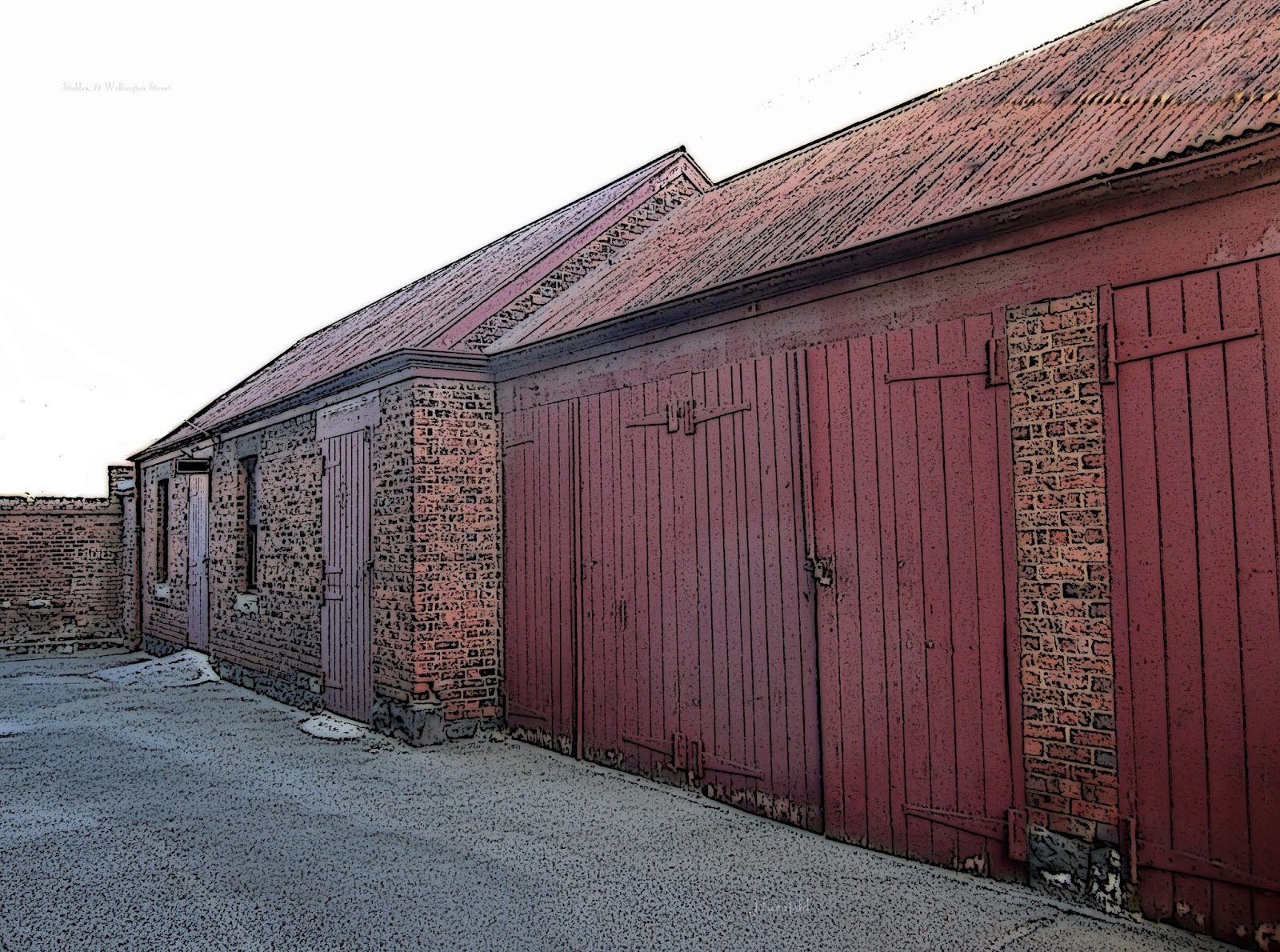
STABLES - 22 WELLINGTON STREET

STABLES ON BAPTIST CHURCH SITE, WELLINGTON STREET
In the late 1850s Henry Davy Parr took over the Royal Hotel at 22 Wellington Street (currently the Baptist Church Offices – see last week's post). 

 He is reputed to have spent some two thousand pounds developing the site, building stables in 1857, and making other improvements, and the establishment became known as “Parr's Family Hotel”.

Henry Davey Parr was a remarkable man. His obituary, published in The Examiner on 01 February 1878, is well worth reading. It omits to mention Parr's passage to Tasmania (compliments of the British government – he arrived as a convict in 1833). Apart from “publican” Parr was variously a farmer (at Westbury), veterinarian, horsebreeder and trainer, owner of the Mowbray racetrack, and proponent of a (sadly) ineffective cure for cancer!! He seems to have been well-respected and liked, renowned for his “smiling countenance.” Prior to the Royal, Parr was licensee of the Australian and Tasmanian Hotel, the Queen's Head Hotel (also in Wellingon Street), and afterwards, the Post Office Hotel, and Temperance Hotels in Paterson street.

Parr's hotels were not favoured by dedicated drinkers and were thus known as a comfortable and safe place to stay. This was particularly notable at a time when many of the residents of Wellington Street were said to be too scared to venture out after dark!

Parr continued to operate the hotel until the 1870s when it was purchased by Henry Reed who was keen to establish an evangelical mission to the people of Launceston. More next time........

Saturday, 22 November 2014

THE BAPTIST CHURCH OFFICES - 22 WELLINGTON STREET

THE BAPTIST CHURCH OFFICE TODAY

This is the first of four postings about a remarkable set of buildings located at Wellington Street Launceston.

Before it became the Baptist Church Office, the building at 22 Wellington Street, between the Church and Regal Press was initially a house, but for many years after that operated as a hotel.

I haven't been able to find out who undertook the initial construction or when it occurred, but an article in the Cornwall Chronicle of September 26th 1846 makes mention of Benjamin Hyrons building a “substantial and lasting structure” in the vicinity of Charles and Wellington street so it seems probable that he may have been responsible, especially as when the house was converted to an inn in 1851, Hyrons was granted a license to operate the business under the name of “The Royal Hotel”.

An interesting biography of Hyron, an ex-convict who established an extensive business network in early Tasmania, and whose broad interests included many inns in both the north and south of the state, as well as early transport and mail services can be found at http://innshumpagegoodegreenwell.familytreeguide.com. Benjamin Hyron's enterprises, included stagecoaches which left from the Royal Hotel immediately after steamers from Port Phillip arrived in port. He offered to deliver his passengers to Hobart within twelve hours.

In 1853, the hotel was advertised for sale, as was Hyron's brewery which was probably also located on the site. According to QVMAG's informative article about Launceston's industrial heritage, Hyron offered “the best ale in Launceston” for sixpence a quart if customers brought their own vessels.

Other proprietors followed Hyrons, but the next licensee of note was Henry Davey Parr, who developed the site further, and added the stables – the second oldest structure on the site. More about him next posting....

Note: Its been very hard to get a photo of this building without it being obscured by vehicles, even in early morning semi-darkness! Then there are telegraph poles obscuring the front, wires everywhere etc etc etc. I have had a bit of a go at doing something presentable, but fortunately the lovely Lee, who has had a long association with the Baptist Church not only provided lots of useful information to use in this series, but also some photos taken during the early days of the church, which give a much better view of the building.

AN EARLY PICTURE OF THE ORIGINAL BUILDING AND NEW CHURCH

Saturday, 26 July 2014

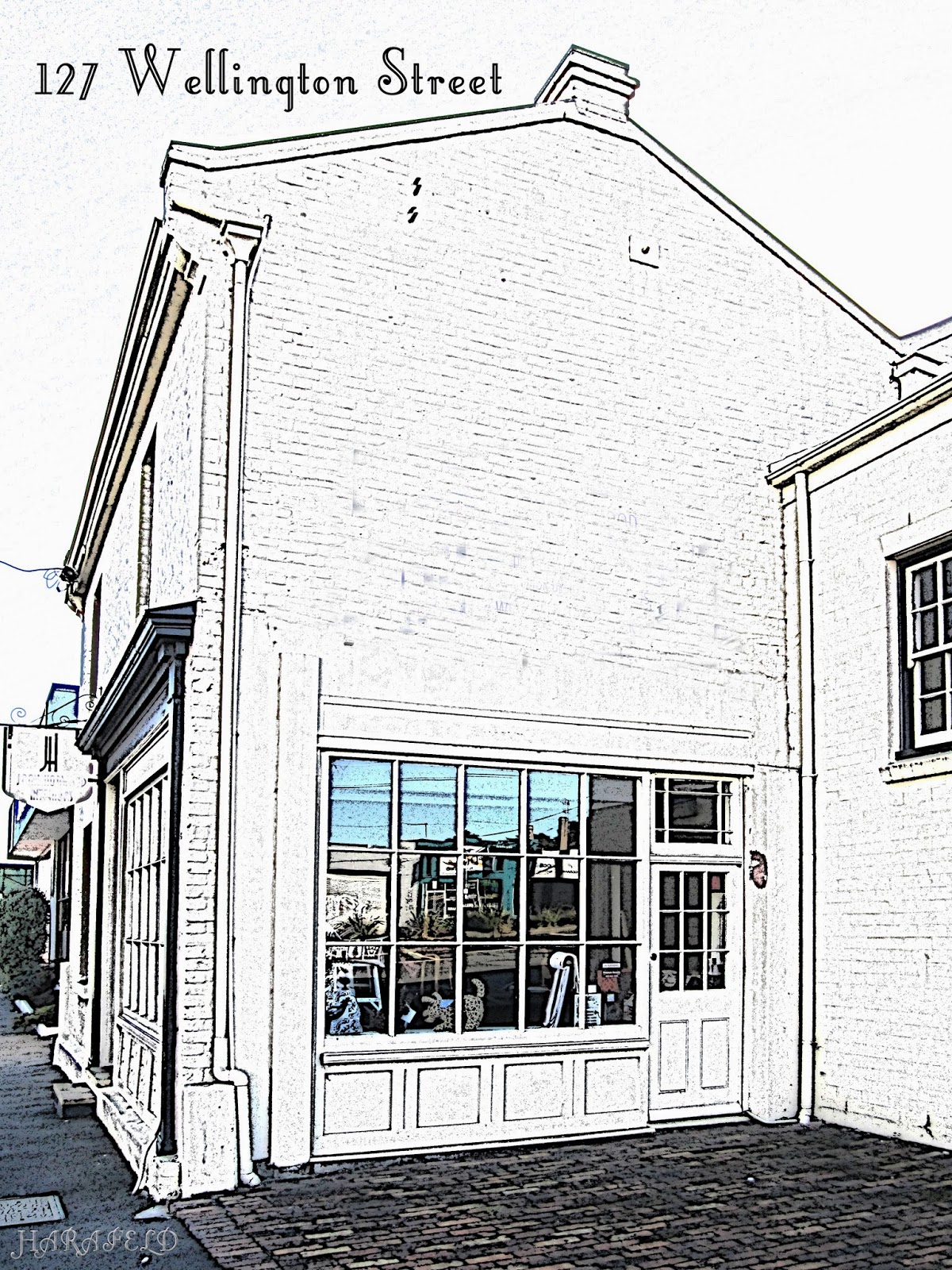
127 WELLINGTON STREET

 127 Wellington Street has never drawn my attention before, although I must have driven past it thousands of times. It was only when I walked by, for the first time, that I noticed some rather attractive “doodaderry” (as pictured) and decided to find out more.

This little building, which today houses an interior design business, has been on the heritage register of the national estate since 1978. According to the Heritage Database Site, it was constructed in the 1840s as a house, and had a shopfront added at a later date, along with various other modifications.

The first reference I could find in the newspapers (via TROVE) was 1894, when James Thomas, of this address was accused of stealing some chooks and a couple of stringy bark posts from his neighbour. The same year an advertisement was place seeking “a young lady to teach sewing,”but the nineteenth century otherwise remains a bit of a mystery. It is not surprising, as street numbers were not usually given until around 1892.

The property has a number of mentions in twentieth century newspapers, the saddest being a report about little Francis McCullagh who died in 1927 when the woodpile he was playing on, collapsed.

I don't know when the shop was added to the main building, but it existed in 1928 when the premises what known as “ The Leading Butchery.” In 1903, someone from this address advertised for the return of a lost sheep and lamb, so probably it was a butchery then too.

In 1930, two youths responsible for a series of robberies in Launceston, were recaptured at this location, the home of Elizabeth Jordan, after they had escaped from the lock-up. The youth's crime spree is recounted in The Mercury of 25 October The two young men claimed that they were encouraged in their endeavours by Elizabeth.

The building underwent a change of usage when 1937 Walter Gillam opened a home for old men at 127 Wellington Street.

In 1976, the building became the Commercial Traveller's Club. The club closed in 1988.(For more information about the Commercial Traveller's Association see http://www.qvmag.tas.gov.au/upfiles/qvmag/imglib/collections/CHS56%20Commercial%20Travellers'%20Association%20of%20Tasmania%20(CTA).pdf ).

127 Welllington Street has since been occupied by an electrical repair shop, and as mentioned at the beginning, an interior designer.

There are clearly many missing details in this account. A peek in Post Office Directories, phone books and so on would no doubt fill in many of the gaps. I haven't done this as....well.... to be honest, I'm not really that interested (I will no doubt soon find out that I've missed some truly earth-shattering historic event which occurred on the premises because I didn't bother to find out more!). Hopefully the information I have included gives some insight into how a single building can have many uses over time and illustrates that each of Launceston's “less grand” older city buildings can provide an insight into the story of small business that is often overlooked, but which is a vital part of the commercial history of Launceston.


Saturday, 12 July 2014

CORNER OF WELLINGTON STREET AND YORK STREET

CORNER OF WELLINGTON AND YORK STREET
A visitor to Launceston asked whether or not the Jailhouse Grill was ever a jail. “Oh no”, I replied, then “well.......I don't think so......actually I'll find out!”

My first instincts were right – the Grill's own website helpfully provided the information that in was built as a pub, The Prince of Wales, in the mid 1800s, from bricks made locally by convicts, and had subsequently operated as such albeit under other names – The Richmond Hotel, Barnaby's Hotel and the Ball and Chain Grill. (www.jailhousegrill.com.au/about.htm).

Its a little confusing tracking the building via early newspapers as there was a second “Prince of Wales” at Evandale, and its not always clear to which establishment articles refer. There also seems to have been another hotel called the Dolphin, located on the corner of Wellington and York Streets during the 1840s. It is also worth mentioning that the building formerly known as the Courthouse Hotel, also in Wellington Street, did have a police lock-up attached....but that's a story for another week.

It seems that John Hinshaw in September 1843 transferred his licence from The Kangaroo Inn to the Prince of Wales. When the licence was reviewed in 1847, the premises was found to be clean and respectable, and there had been no convictions, however....the committee heard that the police constable had found the landlord seemingly drunk when the inspection took place. Hinshaw explained that he was simply responding to a joke, (sadly we'll never know the details) and the licence was duly granted. (Examiner 04 September 1847).


The hotel was still known as the Prince of Wales in 1940, (when a pint of Kentdale lager “straight from Melbourne” could be had for 1/1 a bottle), and I despite spending an evening on-line and emptying my bookshelves (well...not quite..but still....) I haven't found any information about how the building was used after that time. Perhaps someone could help provide extra details?

Saturday, 5 July 2014

114-116 CAMERON STREET - STRUAN AND SUPREME COURT BUILDING

114-116 CAMERON STREET - STRUAN AND SUPREME COURT BUILDING
Struan was built by James Robertson in 1870, at a cost of around six thousand pounds. It incorporated many “features” worthy of comment at the time including hot water, piped up from the kitchen stove to the upstairs bedrooms. The architect was Peter Mills, and the builder E. Ford.

Aspects of Robertson's life reads like a story from a Victorian Boy's Own Annual with tragedy (a brother who drowned in the South Esk), adventure (a memorable encounter with a dangerous bushranger), mercantile success (as evidenced by the bricks and mortar of Struan), and more! According to his obituary, published in The Cornwall Chronicle of 03 April 1874 (which can be read on Trove), he resisted much encouragement to enter formal politics, but was still greatly involved in community pursuits. He was, for instance, among many other things, captain and paymaster of the Voluntary Artillary Corps. According to Beverley Heathcote in her book A Walk Through Launceston's History, John Robertson was “well-known....for driving around the town in his open carriage flanked by his two dalmatian dogs.”

When Robertson died in 1874, central Launceston paused – most of the city's civic leaders attended the funeral, and shops were closed along the route between Struan and the Scotch Cemetery, which was located in High Street. Mrs. Robertson died in 1891.

In 1891, Struan was used as a residence for the Governor during the Tasmanian Exhibition. Bennell Brothers did the necessary refurbishment. At that time The Examiner (14 October) stated that the grounds contained “two of the finest magnolia trees in Tasmania.” I suspect they are no longer there, but I will look next time I'm passing! Dr. Pike, (who died in 1912), followed by Sister Massey had the house after this time, the latter operating it as a hospital until August 1919.

In 1920, Struan was purchased for 7,000 pounds by Dr. Arthur E. Panting from Zeehan who re opened it as a private hospital, which it remained until 1927. At that time there was a proposal to us it as a maternity hospital, but sufficient funds could not be raised and it was decided, in 1928, to consider making it the site of the new Supreme Court instead. At that time the house was located on over an acre of land. Work began on 01 July 1929. S.R. Featherstone was the contractor. The law offices of the new courthouse were located in Struen House. At the time of its official opening, the new building works had cost 9,000 pounds, with plans for additional development.

In 1929 Struan played a unique role after the disastrous floods of that year. The Examiner of May 03 reported: “It is almost unbelievable that during the couple of weeks Struan central sewing depot (in charge of the Australian -Women's National League) has been in existence over 1200 garments
have been issued for the relief of those who suffered through the flood. The official record kept by the secretary of the league shows that to date 776 new garments have been cut out and distributed to work parties, while 600 second-hand garments have been remade.”

It goes without saying that there are many stories from the Supreme court from after 1930 that could be told.

There are a lot of photos available on-line, of Struan in past times One example can be found at: http://catalogue.statelibrary.tas.gov.au/item/?id=PH30-1-5027#urls.
I was tempted to remove the phone box from the photo but it occurred to me that in twenty years or so (probably less) this will, in itself be “of historic interest!” Be aware that it is the back of Struan that “fronts” Cameron Street. Not surprisingly the house was built with an outlook to the river.

Sunday, 1 June 2014

15 WELLINGTON ST - THE KANGAROO INN


Building began at 15 Wellington Street in 1824, when a cottage was built by James Lyford. A variety of businesses were subsequently conducted on the site including a theatre, a bakery and stables, but it is best known as “The Kangaroo Inn.” The Inn was licensed between 1835 and 1842.

Many of the early hotels in Launceston doubled as community meeting places. St. John's Masonic Lodge had its foundations in a meeting held at the inn in 1842. Inquests were also held on the premises.

One suspects that many interesting stories could be told (and hopefully might be discovered) about the “Victorian Theatre”, as it was also known. An advertisement from the Cornwall Chronicle of 26 November 1842 reads:  "Mr REA (from England), the celebrated Ventriloquist, Mimic, Performer of Mechanical figures, Deception &etc, &etc, will perform at the Kangaroo Inn (for the first time in this colony), on the evenings of Monday, Wednesday and Friday.  Boxes 4s, Pit 2s 6d."

In her book, A Walk Through Launceston's History, Beverley Heathcote gives more details about the Kangaroo Inn as well as some fascinating information about the theatre manager George Coppin who, amongst other things, was later to supply Burke and Wills with camels!!


(More details can  also be found at the Australian Heritage Database:
http://www.environment.gov.au/cgi-bin/ahdb/search.pl?mode=place_detail;place_id=16101)