Showing posts with label George Street. Show all posts

Saturday, 21 November 2015

3-7 GEORGE STREET WAREHOUSE

GHOST SIGN
CASCADE HOUSE, GEORGE STREET
Although they have now relocated, this warehouse in George Street was for most current-day Launceston residents the home of Tulloch's Auctions.

Broomby and Dent were agricultural agents – involved in the sale of everything from animal feed, to flowers. They already had the warehouse when they purchased adjoining property on the corner of the street in 1909 – one suspects the current building has evolved into its current form over time.
(A picture of how it looked around 1907 can be seen in Michael Simco and Pete Jermy's little book “Launceston on old Picture Postcards”)

A newspaper report from February 1894 says that “Broomby and Dent have taken possession of the store in lower George.street until recently occupied by Messrs R. Newey and Sons. Both men had worked in the field for some time and proposed to store and sell wheat, hay and corn as well as engines to drive chaff cutters, crushing machines and more. At the time it was opened the building enjoyed the advantage of being close to both the railway station and the wharves. In this regard times have certainly changed! Newey's had been hay and product merchants in Launceston since the 1850s, the business having been founded by Richard Newey, who died in 1891.

Instead of Broomby and Dent, the inscription on the front of the building now reads :Irvine and McEachern. They were wine and spirit merchants and also sold cigars and tea, and had previously operated from 128 Brisbane Street. Rather confusingly the building has “Cascade House” on the front, but most newspaper references give the address of “Cascade House” as 38 Charles Street! Presumably there were two buildings with that title, both operated by the same company. I suspect someone out there will know whether or not the title was simply an association with Irvine and McEachern's business, or was related to the brewery in a more direct way. (All input welcome!!!!!)

Among the many enticing products wholesaled by Irvine and McEarchern was AB Tonic wine, advertised extensively in the 1930s. It was said to not only relieve exhaustion, lassitude and depression but to feed “the wasted tissues” and built up the system after influenza and other illness. All this for only 3 shillings!


As far as I can tell this building is not on the Heritage Register, but it stands as a reminder of Launceston's agricultural and commercial history and has a certain solid appeal, that paint aside, has not been overly damaged by overenthusiastic “development.” 

Thursday, 16 July 2015

THE OLD UMBRELLA SHOP - 60 GEORGE STREET

THE OLD UMBRELLA SHOP
Although not Launceston's oldest shop, the old umbrella shop is distinctive because not only does it have a well-preserved street frontage, but still contains  Victorian styled blackwood shop fittings.

Although opened as a grocery shop in the 1860s, it was operated by the Shott family between 1921 and 1979, selling their handmade umbrellas.  Today it is owned and operated by the National Trust.

Initially Shott's moved to the shop next door to this one.  Reading a description of their wares from an advertisement in the Examiner in December 1909, makes one a little envious, even although some very nice umbrellas can still be brought in George Street today.

"If it is an umbrella for a man friend, there is a lovely twill silk, with 18-carat gold-mounted ivory handle for 30s. This is made on the best frame, Hoyland's ribs being used, so that the frame can be covered again and again, Silver mounted handles have the reliable Partridge stems and Fox's Paragon frames, and are equally strong and durable, but cheaper than the gold mountings, or course. Then while still thinking or the gift for "father," I must mention canes which can be mounted to any order by Mr. Shott in gold and silver. Umbrellas for women folk are also mounted beautifully in 18-carat gold, and sterling silver on lovely ivory or pearl handles, with cable chain to slip over the wrist. But the greatest of all the novelties is the "spring-opening"' umbrella.  Just touch a spring in the handle and the umbrella simply opens itself, slips into its slot, and remains securely open. Touch the spring again and it slides down to its closing point, and there you are with a self-acting umbrella. All kinds of beautiful silks in floral panels, striped, checked, and patterned silks and satins, as well as black and white, are in stock, and Mr. Shott will make up a parasol on a reliable Paragon frame at the shortest notice, ranging in the price from 4s 6d to 12s 6d and upwards."
According to Beverley Heathcote's A Walk Through Launceston's History, the land on which the Old Umbrella Shop is built was first granted to surveyor Thomas Scott, and the shop was built as a grocery store during the next decade.  In the 1880s the owner was Daniel Corcoran, and the business was operated as "The White House Grocery."

Thursday, 16 April 2015

72-74 GEORGE STREET, LAUNCESTON

Historic shop - Cnr George and Paterson Street, Launceston
Most of the early supplies for the residents of Launceston came from government stores, but gradually, as more enterprising ex-convicts and free settlers sought ways to independently support themselves and indeed to profit from increasing demand, privately owned shops were built.

This building, now a Mexican restaurant,  may be one of the earliest examples still standing, possibly dating to 1824.

It has housed many enterprises over the years, including Allen's Confectioners in the 1890s (Steamroller lollies are said to have been first made here).  Roses Big Novelty Store was a later tenant, and composer Alex Lithgow lived upstairs!  (This information has come from Beverley Heathcote's book A Walk Through Launceston's History).

George Street was formally named as such the year after this building was erected.  I don't know whether or not this advertisement, placed in on 06th April 1825 in the Tasmanian and Port Dalrymple Advertiser by a Mr Birrell, and referring to his store in George Street relates to this actual building, but it gives some idea of the sort of things that might have been for sale.

"Bengal OP Rum, 22s per gallon, superior Port ,and Cape Madeira Wine at 10s per gallon; large sized cups and saucers, 16s per dozen, Flint tumblers, 12s per dozen; Wine glasses 15s per ditto; Negrohead Tobacco 6s 6d by the keg or in quantities at 8s per lb;  Iron pots 8d per lb;  Writing paper, small size 30s, large size 35s, and best 42s per ream;  Argylshire cheese 2s 6d per lb;  Men's leather hats 7s 6d each, boys Leather Caps 3s 6d each; Frying-pans 5s each; Stock-keepers boots 15s per pair; Sallad (sic) oil 10s per bottle, Whale Oil 5s per gallon;  Wryghte's bitters 60s per dozen;  Elegant dinner services 25 pounds per sett (sic);  Durham mustard 5s per bottle.

Cash, Wheat or Kangaroo Skins taken in payment."


Saturday, 11 October 2014

POSTCARD OF BRISBANE STREET

BRISBANE STREET 1950s
 When a friend showed me this postcard of Brisbane Street from George Street, it was easy to know what I'd be doing in the lunch break!

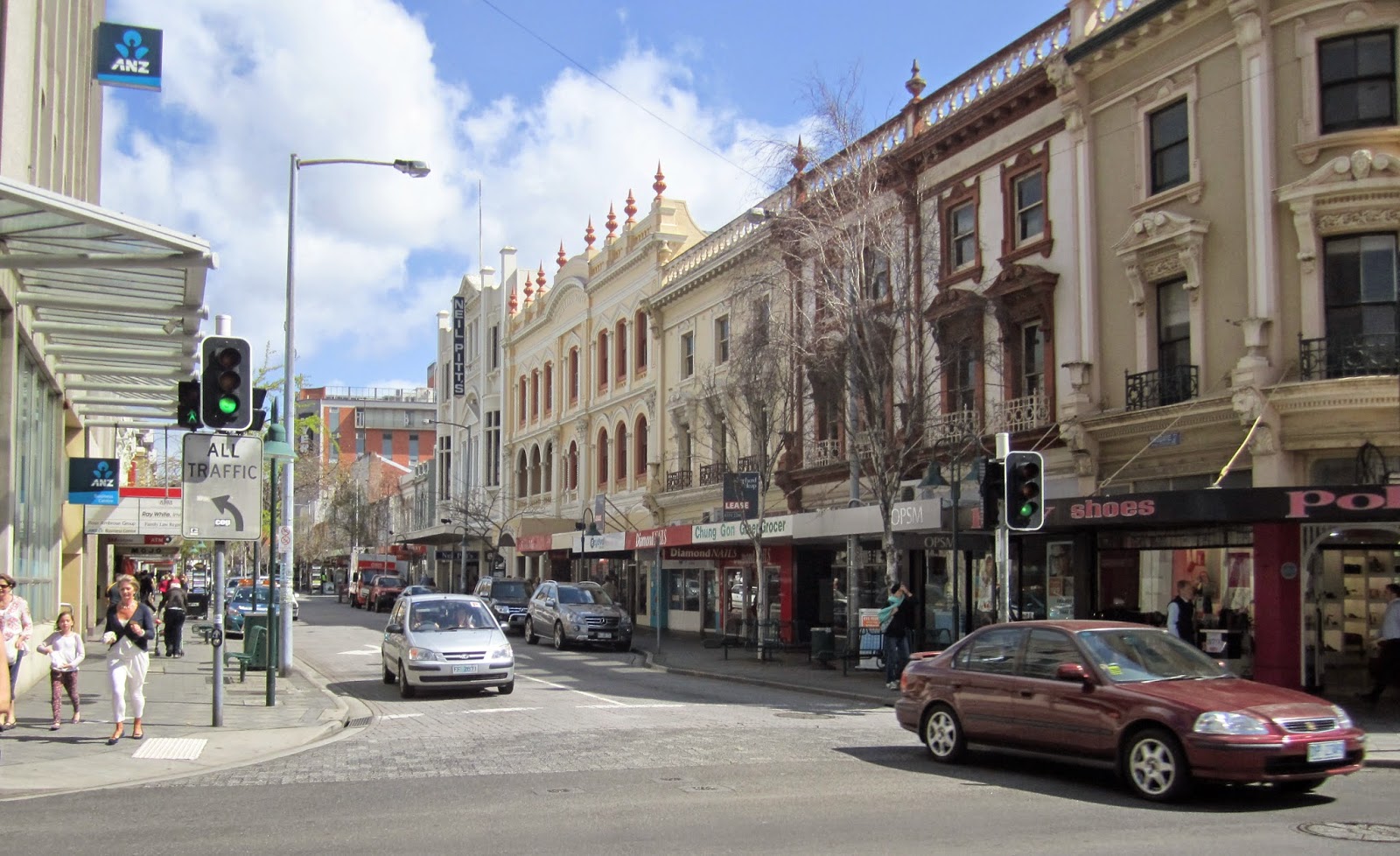
As it was a tad busy I couldn't really stand in the middle of the road to get the same shot but there is enough of the location to play "what's changed".  I'll start you off....two way traffic, a mall at the end of the block, the Myers building, traffic lights, clothing styles, car and truck models, lighting .......and so on...........
BRISBANE STREET 2014
The ANZ bank now stands on the site that was then Findlays.  The latter moved to the site (known then as Bungey's corner after the clothing store that occupied the premises) in 1925.  From their newspaper advertising, it seems that Findlays sold pianos, sheet music, gramaphones and records, radios, hearing aids and (somewhat surprisingly) sewing machines!
The firm was founded by Percy Findlay (a photo and brief biography can be found on the Launceston Family Album site), and had branches throughout the state.

The real surprise for me regarding the John Sands postcard, however, was the photographer - Frank Hurley.  Although I had been aware that this renowned Antarctic, Pacific and war photographer, and pioneer film maker, began his career in postcards, I did not expect that he would have been doing the same towards the end of his life, and in Launceston too!  (I don't know why I felt this way - its a perfectly reasonable thing for a photographer to be doing, especially one aged in his seventies! ).

There is a great deal of information about Frank Hurley available on-line, as well as the opportunity to view many of his photographs.  There are also many books including Frank Hurley - A photographer's life by Alasdair McGregor.

The photo appears to have been taken in the 1950s.  Hurley died in 1962 so it was obviously before then.  Although its hard to see, it appears that the Myers building is not there - that was built in 1960. The cars and clothes would suggest perhaps the late fifties.

Saturday, 20 September 2014

37 GEORGE STREET

37 GEORGE STREET W C OLDHAM

The building pictured, on the corner of Cameron and George Street (37 George Street) As with a great many Launceston buildings, one has to look up to get the most interesting view. There's nothing remarkable about, it but it is attractive, and fairly typical of its time. It was built as a wholesale wine and spirits outlet, but, as The Examiner put it “although of modest of modest dimensions and unobtrusive appearance, it was the centre of a widespread business organisation.” Perhaps surprisingly, I can find no reference to the actual building (other than advertisements for its wares which varied from cigars to scotch and tea!), but I suspect we can trust that it was constructed around 1909 by W C Oldham!

When William Claude Oldham died in 1933,He had been chairman of the Launceston Public hospital board for many years. Prior to this he had stood for state parliament, and had been elected mayor of Launceston in December 1909. In the latter capacity, he had, among other things, formally opened the tramway in 1911, and the Princess Theatre in the same year. William Oldham was involved in a wide variety of Launceston concerns ranging from kindergartens to the Permanent Building Society. More about William Oldham can be found by looking at His obituary, published in The Examiner 12 June 1933 (available via TROVE).