Showing posts with label Shops. Show all posts

Friday, 20 October 2017

17 QUANDRANT MALL - THE INGLES BUILDING

INGLES GROCERY STORE, , THE QUADRANT MALL
The Ingles family began their grocery business in Paterson Street Launceston in 1882, after David Ingles and his family emigrated from Scotland to Launceston in 1881. A year later they moved to the Quadrant. A new shop was built next door to the existing one in 1896. Among other innovative features was electric lighting! The three storey building that still stands in The Quadrant was built in 1910, by the firm of Hinman, Wright and Manser and gives its name to nearby Ingles Lane.

There were branches of the Ingles business in both Launceston and Hobart (Elizbeth Street), and their early success was no doubt a relief as David Ingles was twice widowed, three times wed, and, according to one source, had a total of twenty one children! (His obituary in The Examiner suggests two wives and less children but it seems probably that they were not aware of family in Scotland.). There is a picture of one of the adult children, David Ingles jnr in the Launceston FamilyAlbum - a collection of photographs and stories of those that attended the 1890 Exhibition, which can be viewed on line (http://www.launcestonfamilyalbum.org.au).

A photograph of the interior of the shop taken in 1913 can be viewed on the LINC website.

David Ingles died in 1921, at which time he was living at 100 York Street. At least three of his sons who were directly involved in the business died in the 1940s. I have spoken to someone who remembers the shop still operating in the 1950s, and although I don't know when it closes, suspect it was some time during this decade.  The latest TROVE reference I can find is an advertisement for an experienced grocer, from 1954.


Friday, 17 February 2017

118 - 120 BRISBANE STREET, BIRCHALLS

BIRCHALLS, BRISBANE STREET MALL
Shopfronts change, businesses move in and out, and the city is almost a living entity in that it grows and evolves over time. Generally I embrace the interest and energy of change, but every now and again I just don't want to let go. I am not alone in feeling a sense of almost personal loss at the looming end of Birchalls, the heart of the mall, and almost everyone's favourite shop. 

Usually I play around with the photos doing things like taking out annoying power lines or accentuating the structure, or just playing for the sake of it, but this photo is just Birchalls as it is in February 2017, early in the morning before the customers arrive. It seems right to present it “as is.”

There are a lot of references on-line about the business, plus of course, you can look up lots of information and early advertising in newspapers of the time via TROVE. Birchall's site contains a brief history as well. I don't know if this website will continue to be available, so if you are interested you should look now! I won't “re invent the wheel” and rewrite it all here but......


In summary the business has operated on its current site since 1844. Prior to that, the Brisbane Street site had been occupied by a pharmacy and later, by a confectionery shop. Birchalls is credited with the invention of the writing pad, and has always stocked books and stationary. Art supplies have been sold since the early twentieth century, and various other sections ranging from toys to cake decorating, giftware to snacks, have been established to cater for local demand. It really has been the very best sort of department store – and I cannot begin to say how much it will be missed.

Saturday, 11 June 2016

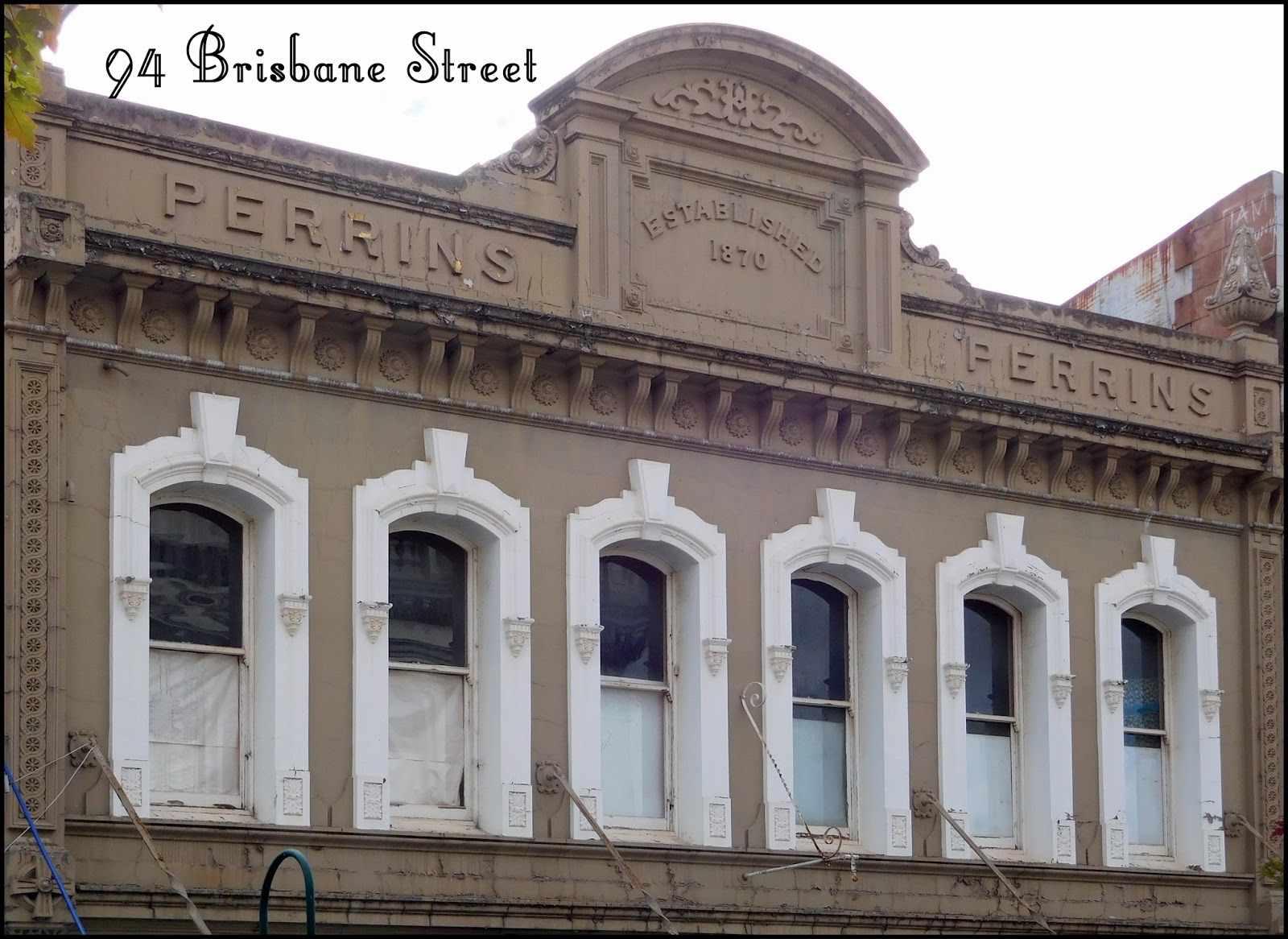
94 BRISBANE STREET - PERRINS DRAPERY part two

PERRINS DRAPERY, 94 BRISBANE STREET
Hold on to your hats (and trims).......this is part two of the Examiner's article (early advertorial?) for Perrins drapery , built in the late 19th century by J & T Gunn which once had pride of place just over the St John Street intersection, in Brisbane Street.

The reporter from The Examiner, recounting the treasures that could be found in the shop in September 1898, was enthusiastic. They wrote:

“The show-room has a very special display of French and English millinery, that is at once tasteful and stylish, generally speaking, although of course rather daring combinations of tones appear occasionally. The "Mushroom" hat. is evidently a leading shape, and should, on its own merits,
become very popular, there being certain amount of simplicity accompanying the newness that should prove a recommendation. These have a drooping brim, and rather wide, flat crown, usually chiffon or gauze is used to drape round the crown and over the brim, some flowers being placed under the brim, near the back,and a rather high- mount of waving quill feathers, with ribbon at the back. Satin straw has all the favour—no doubt this is owing to its extreme lightness and softness. A very stylish "Mushroom" hat of deep yellow satin straw, I admired immensely; it was trimmed in front with gauze ribbon of its own tint, and black lace and sequin wings, while under the brim, at
the back, was a spray of deep yellow crushed, roses and. bright autumn leaves.”

After breathlessly describing the Arline hat, a French bonnet and any number of trims, The Examiner's writer describes (in a similar amount of detail) the children's section, and selections available in blouses, underclothing (available in a clearly impressive choice of 3 sizes), skirts and corsets . Evidently “tweeds suited for cycling costumes”..were “well represented”. (Maybe not as comfy as lycra but surely more classy). “The fancy department” provided “all the latest fripperies,”
and there were gloves to suit everyone and “evening gloves of all classes.”

An undated photograph taken when Perrins were still operating can be viewed on the LINC website.
Perrins were still trading in the 1950s.


Saturday, 4 June 2016

92-94 BRISBANE STREET - PERRINS DRAPERY

PERRINS BUILDING, 94 BRISBANE STREET
I was a little bit confused at first when I tried to find out a little more about this building, which again illustrates the advice I'd give to all tourists (and locals!) in Launceston – look up! It is located in Brisbane street and is now home to Lovisa and Gloria Jeans. The uncertainty arose because the building indicates Perrins was established in 1870, and newspaper advertising confirms that Pepper and Perrins were operating in Brisbane Street in this era. QVMAG's ever reliable article on Launceston's industrial heritage, however, dated the building to 1898. Just to confuse things a little more, the drapery of J.Pepper which was associated with Perrins dates back to 1850.

The answer was a destructive fire that occurred in the premises of this large “drapery” store in May 1898. Although some areas of the building were left intact, and fire brigade were quick to act, the damage was extensive, and by September the business had re opened in a new building. The following description from The Examiner 24th September 1898 makes me somewhat envious of nineteenth century shoppers. Not everything improves with time. I wouldn't normally include an article of this length, but as everything in it seemed worth imagining, I think its worth posting over a couple of weeks.

“At the new buildings,Messrs. Pepper and Perrin are now making a splendid spring show throughout their drapery establishment, Central Brisbane-street. The large and attractive premises that have recently been completed for this firm have given them very great advantages in displaying the new importations.

The three large show windows in front afford admirable means of showing dainty goods; and passing through either of the glass entrance doors brings one into a spacious shop that has a full complement of wide, polished counters, with foot rest, and are furnished with comfortable chairs.

A wide staircase of Tasmanian blackwood and pine leads up to the showroom, which is quite the largest in the city; and is fitted luxuriously with carpet, and mirror panels set into the wall, and, full length swing mirrors on the floor. Polished counters of blackwood and pine, and glass showcases round the walls, add to the general appearance.

In the centre of the room a large glass case, set in a frame, with massive base, attracts attention at once, being filled with various kinds of millinery accessories of the brightest and most bewitching varieties.

Costumes, blouses, and millinery are displayed upon stands in various parts of the unusually large room. A fitting room,where customers may fit jackets,costumes, blouses, etc., is a happy thought, and will be the means of abolishing so much approval business - here the fitting can be attended to,
and alterations, if needed, arranged at once.

Welsbach gas lamps, with rose-tinted glass, is used for lighting the showroom, the other parts of the building having electric lamps. Special attention has been given to ventilation, and a splendid lavatory is provided, and altogether Messrs.Pepper and Perrin are to be complimented upon their really fine house of business, in regard to both the building itself and the very complete stock of choice and novel goods that crowd each department. Throughout the building the arrangements for admitting light are excellent, so that customers have every opportunity of well inspecting before they purchase that which they may require.”

Sadly modern fit-outs have removed all trace of the Perrins of old.


NEXT WEEK: What might you have purchased in this fine establishment?

Thursday, 16 July 2015

THE OLD UMBRELLA SHOP - 60 GEORGE STREET

THE OLD UMBRELLA SHOP
Although not Launceston's oldest shop, the old umbrella shop is distinctive because not only does it have a well-preserved street frontage, but still contains  Victorian styled blackwood shop fittings.

Although opened as a grocery shop in the 1860s, it was operated by the Shott family between 1921 and 1979, selling their handmade umbrellas.  Today it is owned and operated by the National Trust.

Initially Shott's moved to the shop next door to this one.  Reading a description of their wares from an advertisement in the Examiner in December 1909, makes one a little envious, even although some very nice umbrellas can still be brought in George Street today.

"If it is an umbrella for a man friend, there is a lovely twill silk, with 18-carat gold-mounted ivory handle for 30s. This is made on the best frame, Hoyland's ribs being used, so that the frame can be covered again and again, Silver mounted handles have the reliable Partridge stems and Fox's Paragon frames, and are equally strong and durable, but cheaper than the gold mountings, or course. Then while still thinking or the gift for "father," I must mention canes which can be mounted to any order by Mr. Shott in gold and silver. Umbrellas for women folk are also mounted beautifully in 18-carat gold, and sterling silver on lovely ivory or pearl handles, with cable chain to slip over the wrist. But the greatest of all the novelties is the "spring-opening"' umbrella.  Just touch a spring in the handle and the umbrella simply opens itself, slips into its slot, and remains securely open. Touch the spring again and it slides down to its closing point, and there you are with a self-acting umbrella. All kinds of beautiful silks in floral panels, striped, checked, and patterned silks and satins, as well as black and white, are in stock, and Mr. Shott will make up a parasol on a reliable Paragon frame at the shortest notice, ranging in the price from 4s 6d to 12s 6d and upwards."
According to Beverley Heathcote's A Walk Through Launceston's History, the land on which the Old Umbrella Shop is built was first granted to surveyor Thomas Scott, and the shop was built as a grocery store during the next decade.  In the 1880s the owner was Daniel Corcoran, and the business was operated as "The White House Grocery."

Thursday, 16 April 2015

72-74 GEORGE STREET, LAUNCESTON

Historic shop - Cnr George and Paterson Street, Launceston
Most of the early supplies for the residents of Launceston came from government stores, but gradually, as more enterprising ex-convicts and free settlers sought ways to independently support themselves and indeed to profit from increasing demand, privately owned shops were built.

This building, now a Mexican restaurant,  may be one of the earliest examples still standing, possibly dating to 1824.

It has housed many enterprises over the years, including Allen's Confectioners in the 1890s (Steamroller lollies are said to have been first made here).  Roses Big Novelty Store was a later tenant, and composer Alex Lithgow lived upstairs!  (This information has come from Beverley Heathcote's book A Walk Through Launceston's History).

George Street was formally named as such the year after this building was erected.  I don't know whether or not this advertisement, placed in on 06th April 1825 in the Tasmanian and Port Dalrymple Advertiser by a Mr Birrell, and referring to his store in George Street relates to this actual building, but it gives some idea of the sort of things that might have been for sale.

"Bengal OP Rum, 22s per gallon, superior Port ,and Cape Madeira Wine at 10s per gallon; large sized cups and saucers, 16s per dozen, Flint tumblers, 12s per dozen; Wine glasses 15s per ditto; Negrohead Tobacco 6s 6d by the keg or in quantities at 8s per lb;  Iron pots 8d per lb;  Writing paper, small size 30s, large size 35s, and best 42s per ream;  Argylshire cheese 2s 6d per lb;  Men's leather hats 7s 6d each, boys Leather Caps 3s 6d each; Frying-pans 5s each; Stock-keepers boots 15s per pair; Sallad (sic) oil 10s per bottle, Whale Oil 5s per gallon;  Wryghte's bitters 60s per dozen;  Elegant dinner services 25 pounds per sett (sic);  Durham mustard 5s per bottle.

Cash, Wheat or Kangaroo Skins taken in payment."


Saturday, 11 October 2014

POSTCARD OF BRISBANE STREET

BRISBANE STREET 1950s
 When a friend showed me this postcard of Brisbane Street from George Street, it was easy to know what I'd be doing in the lunch break!

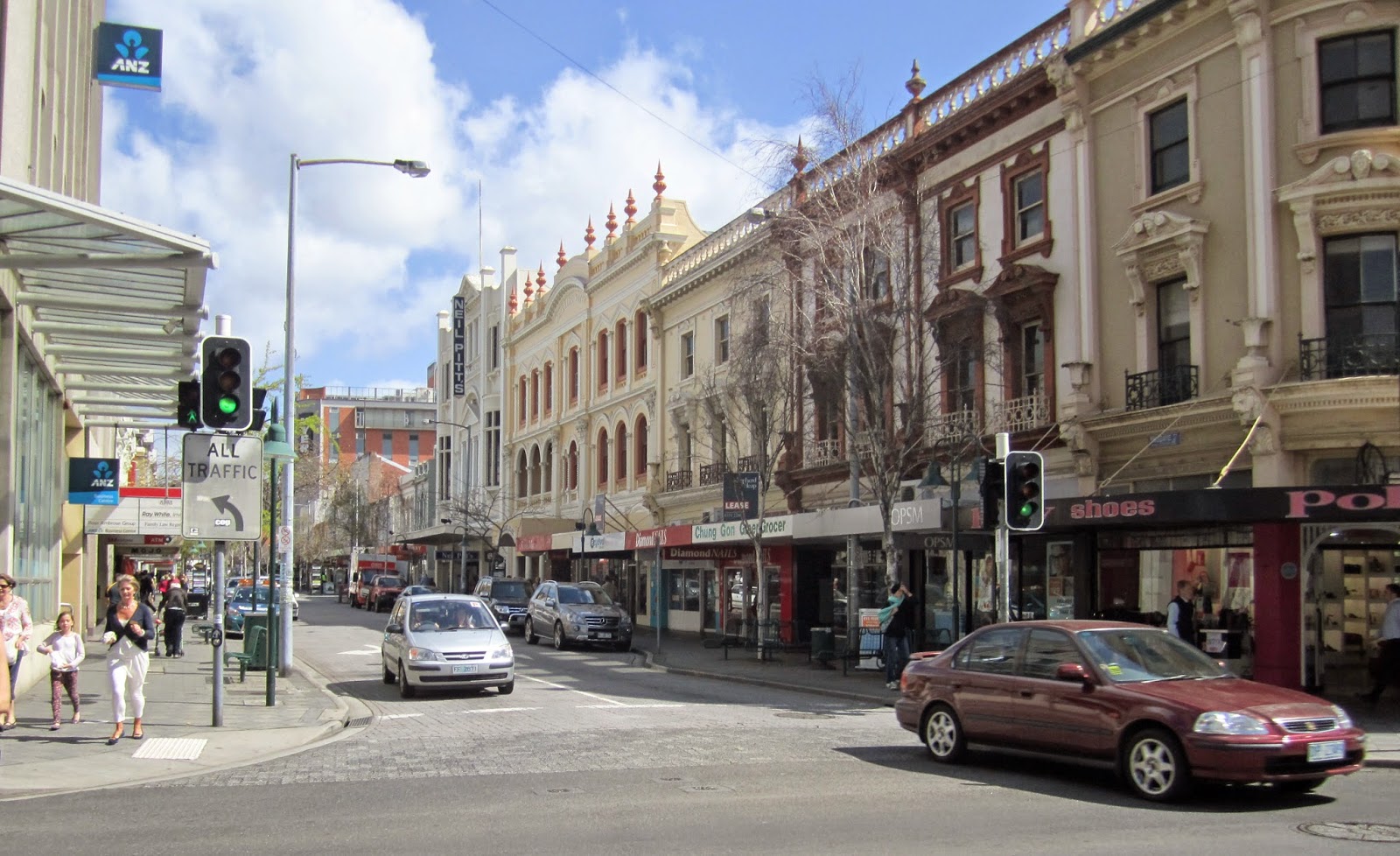
As it was a tad busy I couldn't really stand in the middle of the road to get the same shot but there is enough of the location to play "what's changed".  I'll start you off....two way traffic, a mall at the end of the block, the Myers building, traffic lights, clothing styles, car and truck models, lighting .......and so on...........
BRISBANE STREET 2014
The ANZ bank now stands on the site that was then Findlays.  The latter moved to the site (known then as Bungey's corner after the clothing store that occupied the premises) in 1925.  From their newspaper advertising, it seems that Findlays sold pianos, sheet music, gramaphones and records, radios, hearing aids and (somewhat surprisingly) sewing machines!
The firm was founded by Percy Findlay (a photo and brief biography can be found on the Launceston Family Album site), and had branches throughout the state.

The real surprise for me regarding the John Sands postcard, however, was the photographer - Frank Hurley.  Although I had been aware that this renowned Antarctic, Pacific and war photographer, and pioneer film maker, began his career in postcards, I did not expect that he would have been doing the same towards the end of his life, and in Launceston too!  (I don't know why I felt this way - its a perfectly reasonable thing for a photographer to be doing, especially one aged in his seventies! ).

There is a great deal of information about Frank Hurley available on-line, as well as the opportunity to view many of his photographs.  There are also many books including Frank Hurley - A photographer's life by Alasdair McGregor.

The photo appears to have been taken in the 1950s.  Hurley died in 1962 so it was obviously before then.  Although its hard to see, it appears that the Myers building is not there - that was built in 1960. The cars and clothes would suggest perhaps the late fifties.

Saturday, 20 September 2014

37 GEORGE STREET

37 GEORGE STREET W C OLDHAM

The building pictured, on the corner of Cameron and George Street (37 George Street) As with a great many Launceston buildings, one has to look up to get the most interesting view. There's nothing remarkable about, it but it is attractive, and fairly typical of its time. It was built as a wholesale wine and spirits outlet, but, as The Examiner put it “although of modest of modest dimensions and unobtrusive appearance, it was the centre of a widespread business organisation.” Perhaps surprisingly, I can find no reference to the actual building (other than advertisements for its wares which varied from cigars to scotch and tea!), but I suspect we can trust that it was constructed around 1909 by W C Oldham!

When William Claude Oldham died in 1933,He had been chairman of the Launceston Public hospital board for many years. Prior to this he had stood for state parliament, and had been elected mayor of Launceston in December 1909. In the latter capacity, he had, among other things, formally opened the tramway in 1911, and the Princess Theatre in the same year. William Oldham was involved in a wide variety of Launceston concerns ranging from kindergartens to the Permanent Building Society. More about William Oldham can be found by looking at His obituary, published in The Examiner 12 June 1933 (available via TROVE).