Saturday, 17 September 2016

PRINCES SQUARE DRINKING FOUNTAIN

When one mentions Prince's Square and fountain, the immediate thought is of the magnificent French creation that graces the centre of the park. I will get around to that eventually, but this week thought I'd write a word or two about the humbler, but still quite sweet little drinking fountain.

An entry on ehive.com which includes a black and white photo indicates that the National Trust suggest the fountain (which appears to be the one in my photo) was a gift from Robert de Little. The date given is “unknown” c. 1960 – 1980. I would assume this date refers to the photo as the fountain appears to be much older. (Not that I would claim to know this!).


Robert de Little did indeed pay for a number of drinking fountains for Launceston – he tried to begin a subscription fund to share the cost in 1869, but when no one else contributed he financed the entire project himself with a hundred guineas. De Little, a builder and civic-minded businessman died in February 1876.

 A letter to The Examiner written in 1892, suggests the need for a drinking fountain in Princes Square (so there does not appear to have already have been one there). The same year, the council decided against the erection of a drinking fountain in the square as there was already one on the corner of St John and Elizabeth Streets. Perhaps this was later re-located into the park. An article in ­of February 24th 1924, makes reference to a recently erected fountain in Princes Square, and looking at the decoration, I wonder if this is that fountain, despite the details mentioned above? I don't know.......love to hear from you if you do!

Thursday, 18 August 2016

TAMAR ISLAND

Tamar Island (located in the Tamar Island Wetlands Reserve, just off the West Tamar Highway between Riverside and Legana) was first noted by Europeans in 1804, when it was named “Upper Island.” Tamar Island has always been crown land, but over the years has been used for a variety of purposes, and sometimes privately leased. 

Convict labour was used to reclaim land in the wetland area as early as the 1820s.  In the 1880s it became the base for an on-going dredging operation to allow ships better access to the Launceston port. (This is obviously not a new issue). Derelict ships and barges were also used to try and block part of the river and increase the flow in the main channel. By this time, the island was known as “Pig Island.”

There was a report in The Daily Telegraph (Launceston) in 1900, that mentioned a man with a suspected case of bubonic plague, being confined to “Pig Island.” This seems to have been a pragmatic rather than planned response to the perceived threat.

THE BOARDWALK TO TAMAR ISLAND
As time went on, the recreational potential of the island was recognized. In 1906 there was a privately funded proposal to erect tea rooms and another name change to “Tamar Island” ensued. (Other suggested names included Panogana (white mud),and Kuawatto (afternoon) but the minister had the final say, and clearly favoured the literal). Various expensive ornamental trees were planted, but eventually the plans foundered due to the unforeseen costs involved in building a suitable jetty. By 1917, such plans had been abandoned but despite applications, the Marine Board was reluctant to lease the ground for grazing as livestock would likely destroy the trees.

There are many stories associated with the island. I'ts easy to find the old oak tree that has now all but consumed, a rusted plough once left behind, legend has it, by a grief-stricken widowed farmer who abandoned the land. and you won't find it hard to find lots of references on-line to Bruno the marooned bull.

The Tasmanian state government purchased it in the 1980s, and incorporated it into the Tamar River Conservation Area

https://www.environment.gov.au/water/wetlands/publications/wetlands-australia/national-wetlands-update-february-2012-15 contains interesting information regarding the wetlands of which Tamar Island is an integral part.

The whole wetlands area is a photographer's dream – its great on a sunny day, but in winter, when the trees are bare, the tide is low and the skies are dark and threatening its even better!

Saturday, 16 July 2016

CITY PARK MONKEYS

ONE OF THE CITY PARK MONKEYS
Monkeys were around in Launceston for most of the city's existence, and have been in City Park since the 1800s. Interestingly, there seems to have always been controversy about whether or not it is appropriate to keep the animals as exhibits. As early as the 1890s letters were written to the editor of the Examiner expressing concern for their welfare.

Monkeys were kept as a part of the zoo which existed within City Park, the collection having begun in 1850 with the exhibition of two of the last remaining Tasmanian emus from Circular Head, donated by James Gibson. It seems to have grown into an odd assortment of animals which also included an eagle, hens, deer, dingoes, kangaroos and wallabies. At that stage the gardens belonged to the Horticultural Society, the original aim being to collect representations of both the plants and animals of Australia. Just how or why monkeys were introduced into the mix is still unclear to me
(See http://www.naturalworlds.org/thylacine/captivity/zoos/zoos_7.htm for additional information including the location of the zoo within the park)

The “People's Park” passed into the hands of the City of Launceston in 1863, and by 1895, it was becoming clear that considerable resources were needed to successfully maintain its animals . The council decided to persist with the zoo, the verdict being “if it is to be abolished what will the children say?” A shift in emphasis from scientific curiosity that prevailed when the collections began to its value as an amusement seems to have occurred.

Monkeys remained in City Park in the twentieth century. In 1903 a large African monkey escaped and attacked a tourist from Queensland! By 1913, the council had decided to let the animals of City Park “die out” and a letter to the paper in 1924 confirmed that only one monkey remained, alone and caged, a sad fate for a social animal. The population must however have been replenished at some stage afterwards, as a baby rhesus monkey was born in City Park in 1931. He was named Augustus, and he became a “star” of postcards before he had to be relocated to the mainland because he “became ferocious”.

The Examiner gave the original number of monkeys as five, but by 1954, a single male, known as Joe, remained. The council was hoping to swap him for a couple of “younger and more playful” monkeys from Adelaide!! I don't know the outcome to that particular ambition.

The monkeys in the park today live in a much lovelier enclosure than that endured by those that preceded them. The current residents are Japanese macaques. The original modern population arrived in 1980, swapped for a similar number of wallabies.

Monkeys were always considered a source of entertainment, as well as “specimens” of natural history. Wombwell's Australian Menagerie, for instance arrived in town In 1858. Four lions, a Bengal tiger, a jackal and several monkeys were “on view” on the corner of Brisbane and George Streets! The “American Circus” visited in the 1880s with a “clever” mandrill. Fillis's Circus in 1893 featured pony-riding monkeys, whilst in 1899 Fitzgerald's Circus included a monkey who rode a goat.

Monkeys were also considered suitable pets in the nineteenth century. In 1846 there was an article about a monkey kept in the stableyard of an unnamed Launceston hotel who found money in an old discarded glove – the discovery of the money seemingly more amazing that the existence of the monkey, so one could surmise that whilst not common, they were not unknown in town, Launceston being a major port of call for ships from many corners of the world in the early years.

In 1855, several monkeys were brought to Launceston from Timor and sold for thirty shillings each. I was surprised to read this as it had never occurred to me that Timor was home to a monkey population. A quick consultation with Wikipedia, however, confirmed that macaques do indeed live there.

An 1896 letter to the children's section of the Examiner reads as follows “I must....tell you about my pet monkey. I bought him in Melbourne before Christmas. He was then very thin and miserable looking, but now he is so different and looks so contented and happy. I keep him in a large cage about six feet square, but take him out and nurse him sometimes. I bought a belt and chain for him, but he objects to it just yet. He is very fond of children and has such games with them. It is very amusing to see him with a hand mirror. He feels behind it for the other monkey and feeds it on the glass. His name is Jacko.”

..........and so on.........

This post leads to so many other potential interesting little stories about circuses and exhibitions, about the nineteenth century interest in natural history, about.....well, I could go on and on, but i already have and its time to stop!


Saturday, 11 June 2016

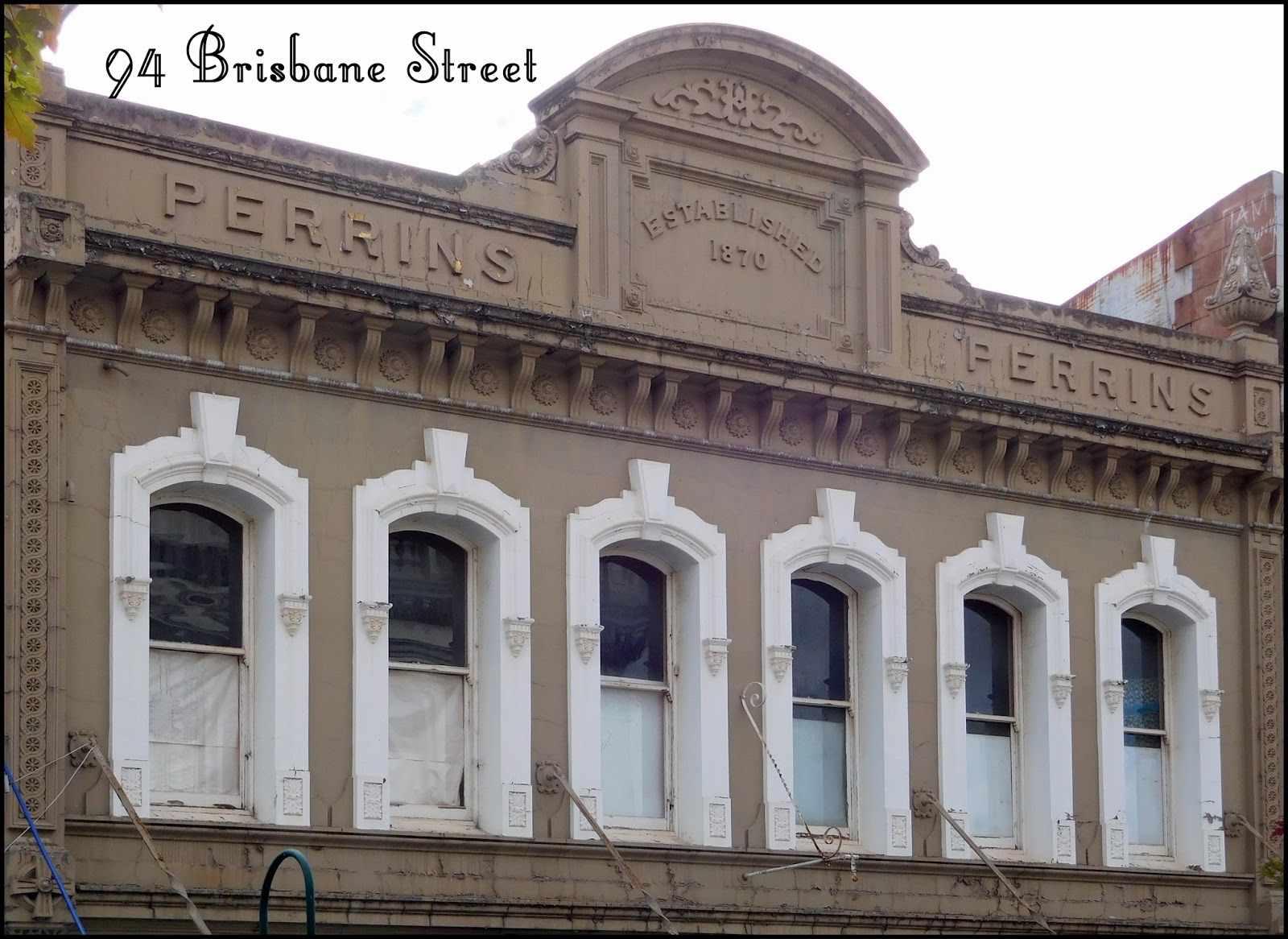
94 BRISBANE STREET - PERRINS DRAPERY part two

PERRINS DRAPERY, 94 BRISBANE STREET
Hold on to your hats (and trims).......this is part two of the Examiner's article (early advertorial?) for Perrins drapery , built in the late 19th century by J & T Gunn which once had pride of place just over the St John Street intersection, in Brisbane Street.

The reporter from The Examiner, recounting the treasures that could be found in the shop in September 1898, was enthusiastic. They wrote:

“The show-room has a very special display of French and English millinery, that is at once tasteful and stylish, generally speaking, although of course rather daring combinations of tones appear occasionally. The "Mushroom" hat. is evidently a leading shape, and should, on its own merits,
become very popular, there being certain amount of simplicity accompanying the newness that should prove a recommendation. These have a drooping brim, and rather wide, flat crown, usually chiffon or gauze is used to drape round the crown and over the brim, some flowers being placed under the brim, near the back,and a rather high- mount of waving quill feathers, with ribbon at the back. Satin straw has all the favour—no doubt this is owing to its extreme lightness and softness. A very stylish "Mushroom" hat of deep yellow satin straw, I admired immensely; it was trimmed in front with gauze ribbon of its own tint, and black lace and sequin wings, while under the brim, at
the back, was a spray of deep yellow crushed, roses and. bright autumn leaves.”

After breathlessly describing the Arline hat, a French bonnet and any number of trims, The Examiner's writer describes (in a similar amount of detail) the children's section, and selections available in blouses, underclothing (available in a clearly impressive choice of 3 sizes), skirts and corsets . Evidently “tweeds suited for cycling costumes”..were “well represented”. (Maybe not as comfy as lycra but surely more classy). “The fancy department” provided “all the latest fripperies,”
and there were gloves to suit everyone and “evening gloves of all classes.”

An undated photograph taken when Perrins were still operating can be viewed on the LINC website.
Perrins were still trading in the 1950s.


Saturday, 4 June 2016

92-94 BRISBANE STREET - PERRINS DRAPERY

PERRINS BUILDING, 94 BRISBANE STREET
I was a little bit confused at first when I tried to find out a little more about this building, which again illustrates the advice I'd give to all tourists (and locals!) in Launceston – look up! It is located in Brisbane street and is now home to Lovisa and Gloria Jeans. The uncertainty arose because the building indicates Perrins was established in 1870, and newspaper advertising confirms that Pepper and Perrins were operating in Brisbane Street in this era. QVMAG's ever reliable article on Launceston's industrial heritage, however, dated the building to 1898. Just to confuse things a little more, the drapery of J.Pepper which was associated with Perrins dates back to 1850.

The answer was a destructive fire that occurred in the premises of this large “drapery” store in May 1898. Although some areas of the building were left intact, and fire brigade were quick to act, the damage was extensive, and by September the business had re opened in a new building. The following description from The Examiner 24th September 1898 makes me somewhat envious of nineteenth century shoppers. Not everything improves with time. I wouldn't normally include an article of this length, but as everything in it seemed worth imagining, I think its worth posting over a couple of weeks.

“At the new buildings,Messrs. Pepper and Perrin are now making a splendid spring show throughout their drapery establishment, Central Brisbane-street. The large and attractive premises that have recently been completed for this firm have given them very great advantages in displaying the new importations.

The three large show windows in front afford admirable means of showing dainty goods; and passing through either of the glass entrance doors brings one into a spacious shop that has a full complement of wide, polished counters, with foot rest, and are furnished with comfortable chairs.

A wide staircase of Tasmanian blackwood and pine leads up to the showroom, which is quite the largest in the city; and is fitted luxuriously with carpet, and mirror panels set into the wall, and, full length swing mirrors on the floor. Polished counters of blackwood and pine, and glass showcases round the walls, add to the general appearance.

In the centre of the room a large glass case, set in a frame, with massive base, attracts attention at once, being filled with various kinds of millinery accessories of the brightest and most bewitching varieties.

Costumes, blouses, and millinery are displayed upon stands in various parts of the unusually large room. A fitting room,where customers may fit jackets,costumes, blouses, etc., is a happy thought, and will be the means of abolishing so much approval business - here the fitting can be attended to,
and alterations, if needed, arranged at once.

Welsbach gas lamps, with rose-tinted glass, is used for lighting the showroom, the other parts of the building having electric lamps. Special attention has been given to ventilation, and a splendid lavatory is provided, and altogether Messrs.Pepper and Perrin are to be complimented upon their really fine house of business, in regard to both the building itself and the very complete stock of choice and novel goods that crowd each department. Throughout the building the arrangements for admitting light are excellent, so that customers have every opportunity of well inspecting before they purchase that which they may require.”

Sadly modern fit-outs have removed all trace of the Perrins of old.


NEXT WEEK: What might you have purchased in this fine establishment?

Wednesday, 4 May 2016

39 William Street

THE TAMAR HOTEL
Well, thought this one would be easy....silly me. Today this building houses Boag's Visitor's Centre in William Street, Launceston. A sensible person would probably stop there however.......

After much looking, the history of the building is still as clear as mud, but I'll go with it anyway if only to illustrate the issues that one can find when trying to research the history of Launceston pubs.

It is important to be aware that various hotels operated under the same name at different locations. Occasionally this was co incidence, but more often the licensee changed establishments and took the name with them. Street numbers weren't commonly used and thus even when you've pinned down the street, the specific location within it can't be assumed (although at least if its on a corner it narrows the location down to four possibilities). Hotels can be rebuilt or modified to such a degree that the existent building bears little, if any resemblance to the original structure. In the past, as much, if not more so than today, typos happened – sometimes newspaper reports give incorrect locations. These are just some of the things that can obscure the facts.

According to Wikipedia: “The Lame Dog Hotel (later known as the Tamar Hotel) was constructed in 1826 and by the 1930s the Georgian style building had become one of Launceston's most notable hotels. George Radford and his family operated the hotel for 26 years. The building was restored to house the Boag's Centre for Beer Lovers.”

An address by E Whitfield recollecting the early days of Launceston and reported in The Examiner on 6th February 1897, however claims that the Tamar Hotel was once known as the Golden Lion and before that as the Sawyers Arms.” and that “at the foot of George Street there was a ferry and near that ferry stood another public house. It was named the Lame Dog.” In other words the Lame Dog and Tamar Hotel were different places.

Whitfield may, however, have been mistaken, as in 1836, Antonio Martini had a hotel called the Sawyers Arms which, depending on which licensing report you read was either on the corner of Tamar and Cameron Street or Tamar and Brisbane Street. (The block may have been big enough to span both adresses?)

A letter of complaint about the state of the road written in 1838 suggests that the Lame Dog was located in William Street between Tamar and George Street.

In September 1831, a license was issued to George Radford for an un named hotel in William Street. The license for the Golden Lion in William Street, passed from him to his son (also named George) in December 1841. An advertisement placed for the hotel in this month refers to it as a “newly erected premises” - hardly true if the building was already ten years old. So was the hotel rebuilt, renovated, moved to another location in the street, or was George just “talking it up?”

At this time, and until at least the mid 1860s, there was a Tamar Hotel, located on the eastern side of the river some nine miles from the centre of Launceston.

When Alf Turner, previously of the Burnie Coffee Palace, took possession of the William Street Tamar Hotel in 1901, he described it as “once known as the Golden Lion”. This would tend to suggest that it had still been known as such in relatively recent times, however in 1874 Benjamin Crow applied for a new licence to operate the Tamar Hotel in William Street, and there was an 1872 report of a fire that began in the stables of “Bank's Tamar Hotel” in William Street,(which destroyed three cottages and damaged others). Might the name have been switched from one building to another in the same street?


Well I don't know if I've confused you, but I've certainly confused myself. I'm sure the mystery of how many hotels were involved, and exactly where it/they were located and how this relates to the Boags visitor's centres, and precisely which year this was built can be solved with further research. One day if the time pixies give me a few more hours in the day I might put in the effort!   

Sunday, 10 April 2016

TAKE THE PHOTO NOW!

A bit of a different post now......  I usually park in the Bathurst Street Car Park and have noticed some changes in the last couple of weeks.  The mural is gone!  I don't know the history of the picture - its been surprisingly hard to track down on-line, although I assume it was part of the Streets Alive event from quite a few years ago.  (Please correct me if this is not the case).  I didn't even realize I'd miss it until it disappeared, and how much I took it for granted until I saw it almost completely covered with grey paint and thought....Oh no!  Did I take a photo of it or not?

As you can see....yes I did.  I did write myself a mental note though.......DO take pictures of the everyday things around you.  Nothing last forever and ultimately it's the everyday things you will probably want to remember and share with future generations more than those exotic once-off holiday snaps.  As you can see from the photos - even a week can change things!
MURAL BATHURST STREET CAR PARK
.  The wall is clearly a work in progress - no editorial about that......
GOING
GONE

Saturday, 2 January 2016

87-89 LINDSAY STREET

VIEW LOOKING TOWARDS GRAIN SILOS, INVERESK

The silos in Lindsay Street, on the “North Bank”, close to where the North Esk joins the Tamar, are undergoing a radical redevelopment into a luxury hotel, so its probably timely to record them as “they are” but probably will soon no longer be.

They are frequently referred to as “an eyesore” (perhaps especially by those favouring the hotel development) but I have never seen them that way. Perhaps because I have never seen the landscape without them they have always seemed to belong just where they are.

The silos were being used for grain storage into this century, but were sold to a private company, The Tasmanian Grain Elevators Board, by the Tasmanian government in 2004. They sold to Tas Silos, who in turn sold to Roberts. The silos were subsequently acquired by the Launceston City Council for “flood protection.” It was later decided that they were not actually needed for this purpose, and so were sold back to Roberts, the previous owners who on-sold them to the current owners Old Launceston Sea Port Pty Ltd.

I have spent quite some time looking for an on-line reference providing more information about the history of the silos prior to this time with little luck, other from newspaper articles.

An article in The Advocate in 1951 refers to the construction of wheat silos by the Tasmanian government and the employment of Victorian consultant engineers to this end, and The Examiner of 7th September 1951 reported the Parliamentary Standing Committee on Public Works had recommended the construction of silos at the southern end of Kings Wharf at an estimated cost of 553 thousand pounds. At that stage, it was intended that the marine board would manufacture the concrete foundations. In 1953 construction still hadn't commenced, as test drilling had proved “unsatisfactory.” In February the following year, engineers had still not been able to find stable ground upon which suitable foundations could be built. Modernismtas.blogspot.com.au mentions that the silos were designed in the “late 1950s.”


In short, I don't have a date, but assume late fifties/early sixties would be accurate. I gather that the “grain” stored in the silos was wheat, but don't know whether or not other grains were stored, nor do I know who ended up designing the silos or building them or even how they “worked” in terms of pick up and delivery Perhaps someone could help with more information?

Saturday, 21 November 2015

3-7 GEORGE STREET WAREHOUSE

GHOST SIGN
CASCADE HOUSE, GEORGE STREET
Although they have now relocated, this warehouse in George Street was for most current-day Launceston residents the home of Tulloch's Auctions.

Broomby and Dent were agricultural agents – involved in the sale of everything from animal feed, to flowers. They already had the warehouse when they purchased adjoining property on the corner of the street in 1909 – one suspects the current building has evolved into its current form over time.
(A picture of how it looked around 1907 can be seen in Michael Simco and Pete Jermy's little book “Launceston on old Picture Postcards”)

A newspaper report from February 1894 says that “Broomby and Dent have taken possession of the store in lower George.street until recently occupied by Messrs R. Newey and Sons. Both men had worked in the field for some time and proposed to store and sell wheat, hay and corn as well as engines to drive chaff cutters, crushing machines and more. At the time it was opened the building enjoyed the advantage of being close to both the railway station and the wharves. In this regard times have certainly changed! Newey's had been hay and product merchants in Launceston since the 1850s, the business having been founded by Richard Newey, who died in 1891.

Instead of Broomby and Dent, the inscription on the front of the building now reads :Irvine and McEachern. They were wine and spirit merchants and also sold cigars and tea, and had previously operated from 128 Brisbane Street. Rather confusingly the building has “Cascade House” on the front, but most newspaper references give the address of “Cascade House” as 38 Charles Street! Presumably there were two buildings with that title, both operated by the same company. I suspect someone out there will know whether or not the title was simply an association with Irvine and McEachern's business, or was related to the brewery in a more direct way. (All input welcome!!!!!)

Among the many enticing products wholesaled by Irvine and McEarchern was AB Tonic wine, advertised extensively in the 1930s. It was said to not only relieve exhaustion, lassitude and depression but to feed “the wasted tissues” and built up the system after influenza and other illness. All this for only 3 shillings!


As far as I can tell this building is not on the Heritage Register, but it stands as a reminder of Launceston's agricultural and commercial history and has a certain solid appeal, that paint aside, has not been overly damaged by overenthusiastic “development.” 

Saturday, 17 October 2015

56 CHARLES STREET -STAFFORDSHIRE HOUSE

FRONT OF STAFFORDSHIRE HOUSE
OK......so this is one of those places that is so much a part of central Launceston that I've sort of overlooked it.........I bet I'm not the only one who didn't know the name of this pink building, nor what was inside (someone did venture to guess that as they had never seen anyone coming or going in daylight hours, that vampires were a possibility.)

The plaque helpfully placed on the building by by the council and National Trust (I would love it if there were more of these) reads “Staffordshire House - Regency Style - built in 1833 as a warehouse-building-shop, the only example in Australia extant. Office of Cornwall Chronicle. Early site of Scotch College. Purchased by National Trust, with help of City Council in 1966, and restored.”

In the late 1890s, Staffordshire House was home to Jackson's locksmiths. It is no longer owned by the National Trust


Today, the ground floor of 56 Charles Street houses the Andrew Inglis Clark Law Library. Someone else has done the hard work before me in finding more information about the building so rather than re-invent the wheel, I'd suggest you look at http://matthewbirrell.tripod.com/pg000008.htm to find out more.  

Friday, 18 September 2015

ST ANDREWS GARDENS PEDDER STREET/HIGH STREET, LAUNCESTON

ST ANDREWS GARDENS - View from High Street
There are a lot of little plots of land in Launceston, easily overlooked, that hold many stories. Such is the case with “St Andrews Gardens” in High Street. The title is perhaps a little overambitious as its more a case of a scrubby paddock with a few trees than structured gardens as such. In any case, the real story lies underneath the rather unkempt grass, because for almost a hundred years (1832 – 1938) this was the location of the city's Presbyterian Cemetery.

Newspaper reports from the years between 1928 and 1952 tended to talk about “the problem” of the Scottish Cemetery. By 1944 it was referred to as an “eyesore”, although there were still 178 graves. A letter to the editor of The Examiner makes reference to a tomb, forced open revealing 5 coffins. Neither the council nor the church seemed keen to take on the responsibility of its development, but eventually in 1952, the area became a park. Some of the graves were relocated to Carr Villa, others remain, hidden from view, and unmarked.
James Robertson who built Struan (see a previous post) was among early Launceston identities to be buried there.

(A little PS that has nothing to do with St Andrew's Park. Whilst searching through TROVE articles for more information I came across a letter to the editor published in January 1872, which suggested that geography would suggest that gold could well be found in “a vacant piece of ground, uncultivated, near some houses and cottages somewhere in a straight line halfway between the Scottish Cemetery fence and the Hobart Town Main Road, forming almost the lowest part of the valley there, going north to the city of Launceston.” So South Launceston residents, if you need some incentive to dig in the garden this weekend................)


Sunday, 16 August 2015

431 WINDERMERE ROAD, ST MATHIAS ANGLICAN CHURCH

CHURCH AT WINDERMERE
Rather more of the “look around” than the Launceston this time.......only a short drive away, though, and still in the Launceston council area. This little church, St Mathias Anglican, at Windermere has one of the prettiest settings in the state.
The land, and a sizeable amount of the money required to build the church was donated by Dr Matthias Gaunt, in 1842, as he had promised his wife that a church would be built, if they moved to an area without one. The bricks were made in Launceston and an article in The Examiner in 1943, suggests that the building of the church may have been achieved with the use of convict labour.

The first marriage took place in the church in 1845 (the year the church was formally dedicated), and the first baptism the year later. The church became an important part of the life of settlers on both sides of the Tamar, at a time when the river was the main “highway.”

A history of the church can be read at http://www.winderdoon.com/community/st_matthias_church.htm.
The cemetery at the church contains the graves of many early settlers, and there are many others buried there in graves that are no longer marked. An article in The Examiner in 1926, said that church records showed that there had, even at that time, been over 300 burials, many of them already lost, due to “the want of a systematic layout.”


Sometime before the mid-1920s the church had fallen into disrepair, and was saved by the efforts of David Medwin of Woodlawn, but by the 1930s, cracks had appeared in the church and fundraising had to be undertaken. It was closed for five months in 1939 while repairs were effected, as it had become unsafe. We owe a debt to the Tamar River community, and their dedication to saving the church. The much admired building would probably otherwise not be here today