Saturday, 3 January 2015

TREVALLYN, LAUNCESTON TASMANIA

TREVALLYN, FROM THE SEAPORT
A bit of a change this week......a few notes about suburban Trevallyn (there will be separate postings about The Gorge, dam etc at some stage).

The first non-indigenous settlers were farmers, although to my eyes the land still looks a bit on the rocky side to the left and the swampy side to the right! As there were no arbitrary boundaries between Trevallyn and the much-later named suburb of Riverside, it seems that most of the land reasonably close to town, but over the river, was referred to as “Trevallyn.”

The actual property by that name was purchased in 1824 by William Barnes, and encompassed land between The Gorge and Cormiston road. John and Don Morris in History in Our Streets, also suggest that the name may have Welsh origins, but mention also, that there is a Trevallyn Road in Launceston, Cornwall. They write that “Mrs June Gee states that an old shepherd who had worked for Barnes said that it was a Welsh name meaning “the hut by the mill”

This is not entirely inconsistent with an account of Trev-alyn - “The abode on the River Alyn, called Trevallyn Hall” which is described in Annals and Antiquities of the Counties and County Families of Wales (1878) as “an ancient place which was long the seat of one of the most venerable families in Denbighshire” (a county in north-east Wales). William Barnes was from Cheshire, the English county that adjoins Denbighshire, so this explanation seems likely. A letter to The Examiner written in 1929 suggests that perhaps its a misspelling of the surname Trevelyn or Trevennel in Cornwall, but the author H I Scott does admit he is just guessing!

Barnes was one of Launceston's earliest brewers (he established the Port Dalrymple Brewery in Paterson Street, near present day Park Street) and grew hops close to the Gorge. The Barnes family went back to England in the 1840s for their son's education and returned with a tutor Henry Plow Kane, who was to become the first headmaster of Launceston Church Grammar School..

William Barnes jnr represented George Town in the House of Assembly and his widow donated most of the land that we now know as “The Gorge” to the city of Launceston.  Portraits of the early Barnes family were donated to the Museum and Art Gallery by present-day family members in 2013. (see http://www.examiner.com.au/story/1576319/family-deserves-citys-thanks/)

From the 1830s. Trevallyn was a source of firewood (mainy she-oak) for the residents of Launceston, and of timber and stone for builders. Dairying was also undertaken. The river was crossed by means of a punt until the bridge was finally built in 1864.

Although the area had attracted residents from the earliest days of settlement, Trevallyn only began to develop significantly as a suburb in the 1880s and 90s, at about the same time as Mowbray and Invermay. It was not incorporated within Launceston city boundaries until 1906, and before that functioned with a separate administration. Trams began running to Trevallyn in 1913– sharing King's bridge with other vehicles.

Trevallyn today has a population of a little over 4,600.


Saturday, 13 December 2014

GATEWAY BAPTIST CHURCH, WELLINGTON STREET

GATEWAY BAPTIST CHURCH
 After her husband's death Henry Reed's widow, Margaret built the larger church on the Wellington Street site next door to Parr's hotel, as a memorial to her husband, and to ensure his evangelical work in the community continued.

The foundation stone of the Gateway Baptist Church was laid on 20 July 1883. A bible, placed in a copper cylinder was buried underneath. The architect was Frank Tyson, and the building contractor John Todd Farmilo. Walter Hiddlestone came from Melbourne after Henry reed's death and was pastor at the time of the opening of the new church, in July 1885.

An article published in 1929, commemorating the fiftieth anniversary of the mission, claimed that prior to the first world war, as many as 1400 people attended services. Whilst such large congregations rarely assemble today, regular services are still held at the church, which continues to address the needs of the local Launceston community within a modern multicultural world, and Henry Reed's legacy remains alive.

Thanks again to Lee for the brilliant picture of the church in its early days.


HISTORIC VIEW OF WELLINGTON STREET

Saturday, 6 December 2014

THE CHRISTIAN MISSION CHURCH - 22 WELLINGTON STREET

BAPTIST CHURCH HALL, WELLINGTON STREET
Henry Reed, an early free settler, whaler, merchant and businessman, was a keen evangelist. (See the entry re: Macquarie House see last week's post) about the health of his horses and used his stables in town, however the story of how the discussion began regarding his buying his Wellington Street hotel involves one of his horses, being exercised by one of his grooms near Reed's house at Mt Pleasant (Prospect), which was spooked by a pig, and bolted, all the way to town. When it was brought under control, it was stabled at Parr's, and it was whilst Henry Reed was retrieving the animal, that the conversation leading to his purchase of the buildings including a skittle alley which adjoined the hotel ( a common addition to hotels of the time), is said to have taken place.

Initial mission work, beginning in 1876, was conducted from the skittle alley (which was described in one account as “an old shed”), but when this proved too small, plans were made to construct the Christian Mission Church, which is currently used as the Baptist hall, on the site. Whilst the church was being built, the stables (see last week's post) were refurbished and used for worship. 

The building had facilities for Sunday School upstairs and a large kitchen for practical ministry to the needs of the poor.  The main chapel was of similar design to a room in Henry Reed's home at Mt Pleasant.  It was opened on June 6th 1880, a few months before his death in October of that year.

 It was not long, however, before even the new church (which could seat 300), despite the addition of an outdoor pavilion, proved too small, for the needs of the growing church and plans were made for a larger building.


Note: Despite the interesting light and shadows, this is a fairly average photo – I'll try to replace it with a better one at some stage in the not too distant future.

Saturday, 29 November 2014

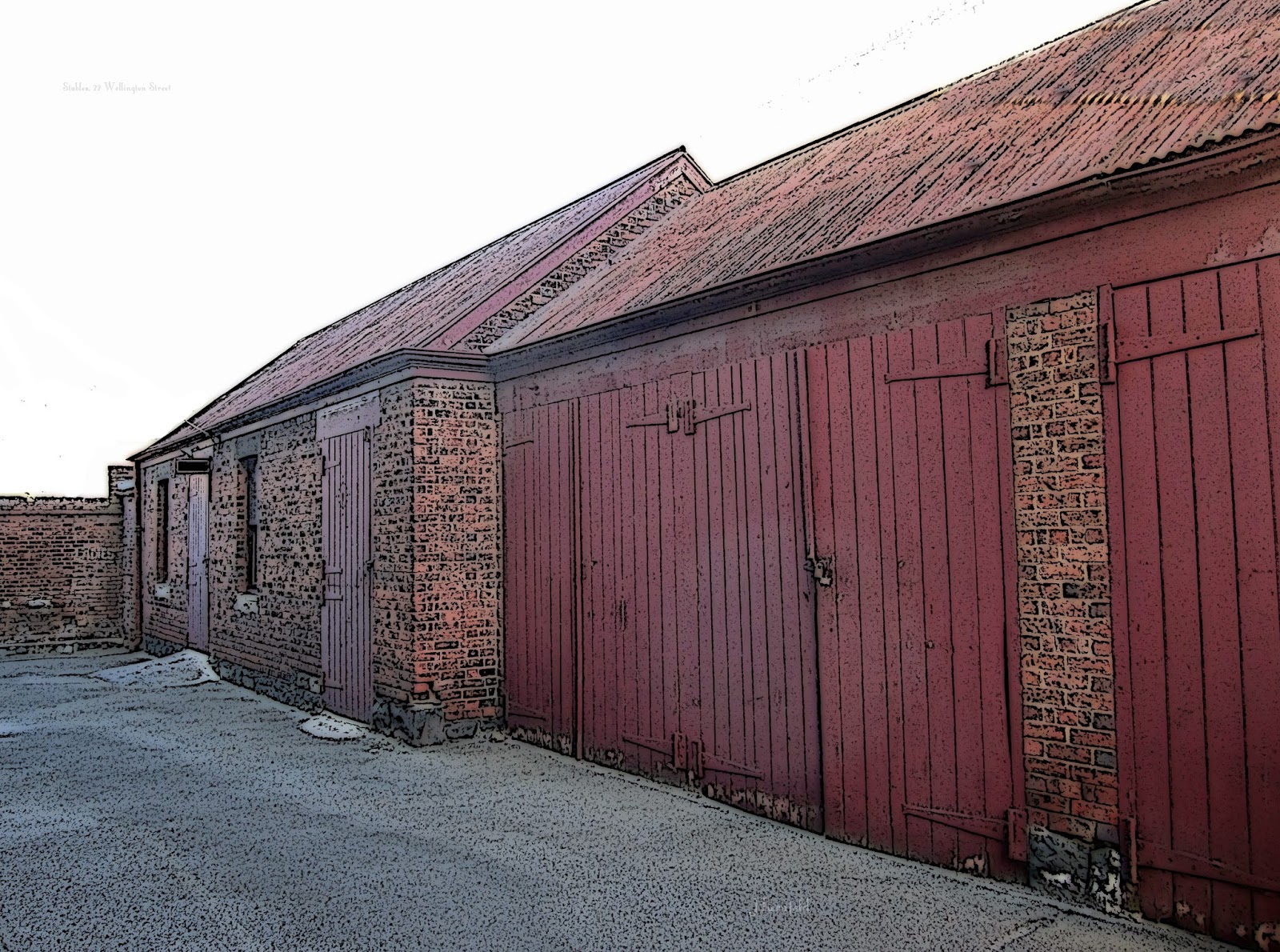
STABLES - 22 WELLINGTON STREET

STABLES ON BAPTIST CHURCH SITE, WELLINGTON STREET
In the late 1850s Henry Davy Parr took over the Royal Hotel at 22 Wellington Street (currently the Baptist Church Offices – see last week's post). 

 He is reputed to have spent some two thousand pounds developing the site, building stables in 1857, and making other improvements, and the establishment became known as “Parr's Family Hotel”.

Henry Davey Parr was a remarkable man. His obituary, published in The Examiner on 01 February 1878, is well worth reading. It omits to mention Parr's passage to Tasmania (compliments of the British government – he arrived as a convict in 1833). Apart from “publican” Parr was variously a farmer (at Westbury), veterinarian, horsebreeder and trainer, owner of the Mowbray racetrack, and proponent of a (sadly) ineffective cure for cancer!! He seems to have been well-respected and liked, renowned for his “smiling countenance.” Prior to the Royal, Parr was licensee of the Australian and Tasmanian Hotel, the Queen's Head Hotel (also in Wellingon Street), and afterwards, the Post Office Hotel, and Temperance Hotels in Paterson street.

Parr's hotels were not favoured by dedicated drinkers and were thus known as a comfortable and safe place to stay. This was particularly notable at a time when many of the residents of Wellington Street were said to be too scared to venture out after dark!

Parr continued to operate the hotel until the 1870s when it was purchased by Henry Reed who was keen to establish an evangelical mission to the people of Launceston. More next time........

Saturday, 22 November 2014

THE BAPTIST CHURCH OFFICES - 22 WELLINGTON STREET

THE BAPTIST CHURCH OFFICE TODAY

This is the first of four postings about a remarkable set of buildings located at Wellington Street Launceston.

Before it became the Baptist Church Office, the building at 22 Wellington Street, between the Church and Regal Press was initially a house, but for many years after that operated as a hotel.

I haven't been able to find out who undertook the initial construction or when it occurred, but an article in the Cornwall Chronicle of September 26th 1846 makes mention of Benjamin Hyrons building a “substantial and lasting structure” in the vicinity of Charles and Wellington street so it seems probable that he may have been responsible, especially as when the house was converted to an inn in 1851, Hyrons was granted a license to operate the business under the name of “The Royal Hotel”.

An interesting biography of Hyron, an ex-convict who established an extensive business network in early Tasmania, and whose broad interests included many inns in both the north and south of the state, as well as early transport and mail services can be found at http://innshumpagegoodegreenwell.familytreeguide.com. Benjamin Hyron's enterprises, included stagecoaches which left from the Royal Hotel immediately after steamers from Port Phillip arrived in port. He offered to deliver his passengers to Hobart within twelve hours.

In 1853, the hotel was advertised for sale, as was Hyron's brewery which was probably also located on the site. According to QVMAG's informative article about Launceston's industrial heritage, Hyron offered “the best ale in Launceston” for sixpence a quart if customers brought their own vessels.

Other proprietors followed Hyrons, but the next licensee of note was Henry Davey Parr, who developed the site further, and added the stables – the second oldest structure on the site. More about him next posting....

Note: Its been very hard to get a photo of this building without it being obscured by vehicles, even in early morning semi-darkness! Then there are telegraph poles obscuring the front, wires everywhere etc etc etc. I have had a bit of a go at doing something presentable, but fortunately the lovely Lee, who has had a long association with the Baptist Church not only provided lots of useful information to use in this series, but also some photos taken during the early days of the church, which give a much better view of the building.

AN EARLY PICTURE OF THE ORIGINAL BUILDING AND NEW CHURCH

Saturday, 8 November 2014

POST OFFICE CLOCK - 68 CAMERON STREET

The clock on the Post Office celebrated its 100th birthday in 2010. 

It was installed some 17 years after the post office, at a cost of 1300 pounds, after a campaign of public fund raising. According to a report in the Daily Telegraph, there was a real desire to have the clock manufactured in Australia but it was not economically viable to do so, and it was made by Gillett and Johnson in England. An official unveiling ceremony was conducted in July 1910, and a “toast was heartily drunk.” A plaque was provided by the building firm J & T Gunn which read: Launceston Centenary Clock and Chimes 1806 – 1906. Erected by public subscription in the reign of Kind Edward VII to commemorate the first centenary of the City of Launceston in Tasmania.”

The clock has been a landmark of Launceston ever since. I remember trips to the city when I was a child and the sound of the clock was second only to the wonders of the Myer escalators in my inventory of “the wonders of the big city.” There was some fierce debate around 2011 as to whether the clocks chimes are “too loud,” and should be silenced at night. You can read an opinion in the negative at http://tasratepayers.blogspot.com.au/2011/07/launceston-post-office-clock-to-silence_09.html. I have to confess that I don't know whether or not the clock is still keeping tourists awake at night but I can vouch for the fact it still chimes during the day – I'm the figure scurrying across Wellington Street trying to get back to work before it strikes one!!

Tuesday, 28 October 2014

CIVIC SQUARE - MACQUARIE HOUSE

Macquarie House - Civic Square

Macquarie House at 92 -94 Cameron Street was built by John Sprunt (who also built the Red Feather Inn at Hadspen), for Henry Reed in 1829 - 30, which makes it one of Launceston's oldest buildings. The four-level sandstone brick building, constructed on a bluestone base, is on the register of the National Estate, once had a shingle roof, and has has been used in a variety of ways since its construction as a warehouse.

Henry Reed is most often described as “a merchant” when mentioned in association with Macquarie House. This understates the importance of a remarkable man who was also variously a whaler and sealer, a trader, politician, a pioneer of the European settlement of Victoria, a landowner and developer, bank director, a church mission worker, and philanthropist. There are numerous on-line and printed references available but the Australian Dictionary of Biography is a good starting point if you would like to know more about Henry Reed. (http://adb.anu.edu.au/biography/reed-henry-2582). A free settler, Reed arrived in Hobart Town in 1827 and (from a Northerner's perspective) made the wise choice to immediately relocate to Launceston, a move he accomplished by walking the entire distance.

Stores from Macquarie House were integral to the success of the first settlement of Melbourne, and provided essential supplies to the people of Launceston. It was also, for a time but despite its great historic significance, by the 1970s, demolition was seriously considered. Fortunately this did not go ahead, and the building's current appearance is the result of a makeover in 1982. Its previous facade dated to the 1930s. A photo taken before the renovation, when it was occupied by Eliza Tinsley, (a supplier of rope, chain and various building products), can be seen at https://www.historypin.org/channels/view/46230/#map/index/#!/geo:41.436115,147.13618/zoom:20/dialog:152123/tab:details/ I can remember dining out at a restaurant located on the bottom floor in the 1980s. Maacquarie House was used for a time by the museum, and is still owned by the Launceston City Council - motion to sell it was defeated in 2013. There is currently a proposal to reshape Macquarie House into an :Innovation Hub. (Details can be seen at http://catalyst-project.com.au/macquarie-house/).


Clearly there is a great deal of history missing in this account. Charles Woolley and Michael Tatlow in A Walk in Old Launceston for instance say that in the 1840s the building was a barrack for the military – I can't find any other reference to this. Beverley Heathcote in A Walk Through Launceston's History, however, does mention that before the warehouse was built “a pipe band would stand on this site just before sundown and, dressed in their bright red coats, white trousers and shining black jack-boots would play the tattoo.” If I come across any more information I'll add it. In the meantime if anyone can suggest any references.......

Saturday, 11 October 2014

POSTCARD OF BRISBANE STREET

BRISBANE STREET 1950s
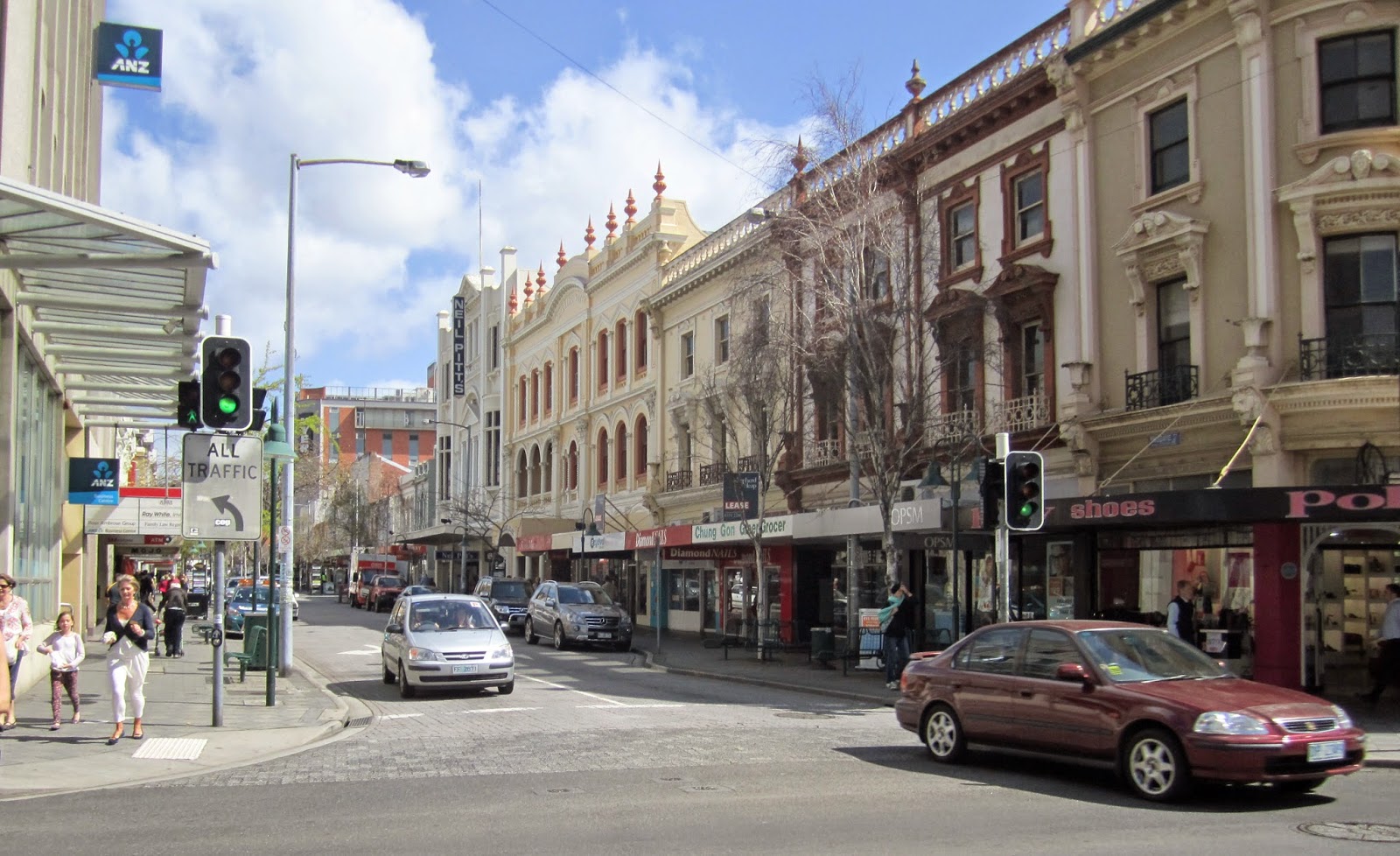
 When a friend showed me this postcard of Brisbane Street from George Street, it was easy to know what I'd be doing in the lunch break!

As it was a tad busy I couldn't really stand in the middle of the road to get the same shot but there is enough of the location to play "what's changed".  I'll start you off....two way traffic, a mall at the end of the block, the Myers building, traffic lights, clothing styles, car and truck models, lighting .......and so on...........
BRISBANE STREET 2014
The ANZ bank now stands on the site that was then Findlays.  The latter moved to the site (known then as Bungey's corner after the clothing store that occupied the premises) in 1925.  From their newspaper advertising, it seems that Findlays sold pianos, sheet music, gramaphones and records, radios, hearing aids and (somewhat surprisingly) sewing machines!
The firm was founded by Percy Findlay (a photo and brief biography can be found on the Launceston Family Album site), and had branches throughout the state.

The real surprise for me regarding the John Sands postcard, however, was the photographer - Frank Hurley.  Although I had been aware that this renowned Antarctic, Pacific and war photographer, and pioneer film maker, began his career in postcards, I did not expect that he would have been doing the same towards the end of his life, and in Launceston too!  (I don't know why I felt this way - its a perfectly reasonable thing for a photographer to be doing, especially one aged in his seventies! ).

There is a great deal of information about Frank Hurley available on-line, as well as the opportunity to view many of his photographs.  There are also many books including Frank Hurley - A photographer's life by Alasdair McGregor.

The photo appears to have been taken in the 1950s.  Hurley died in 1962 so it was obviously before then.  Although its hard to see, it appears that the Myers building is not there - that was built in 1960. The cars and clothes would suggest perhaps the late fifties.

Saturday, 4 October 2014

THE LIBRARY, CIVIC SQUARE


One of the ways I like to "explore" buildings is by playing around with my photo editing programmes - trying to preserve the character of the building whilst removing "distractions" - E.g. keeping the building lines, erasing the cabling etc  and sometimes deciding to do nothing at all as the photo says all it need to say.  Its a way of seeing and appreciating the little details.  But what to do about this building............Suffice to say I couldn't really find anything to appreciate about it and the best I could do was give it a bit of an early seventies colour makeover!!!
If you wish to be further depressed go to http://www.adfas.org.au/downloads/schools/Launceston%20Mechanics%20Institute.pdf and see what was there before!!!!  This is actually a great article about the history of the Mechanics Institute, (which was demolished to make way for this building in the early 1970s) and is well worth a look.

The real joy of this structure, is of course its contents - book and photos, historic collections and more plus lovely helpful people to help us find our way around the treasure trove of resources.  It is now part of LINC, but is almost universally referred to locally as "the library."  Further information is available on the LINC website.

Saturday, 27 September 2014

THE PATERSON BRIDGE, WEST TAMAR HIGHWAY

THE PATERSON BRIDGE, WEST TAMAR HIGHWAY
I have a bit of a tendency to personify structures – insofar as one can feel a bit sorry for a bridge, I feel it for this one – the concrete bridge which is now part of the West Tamar Highway at the mouth of the Cataract Gorge . Talk about coming an unloved second – barely noticed, rarely acknowledged, and treated as a bit of a necessary embarrassment, standing beside its handsome historic older brother. Everyone writes about King's Bridge, which is indeed a beautiful structure (which will no doubt feature in the blog in the not too distant future), but have a tendency to call this one “the second bridge”, the “more modern bridge”, the “other bridge” etc., if indeed it's mentioned at all. Although I travel on it each day, I didn't know it had a name, but it is actually called “The Paterson Bridge", and I would guess that I'm not the only “local” who didn't know that!

The bridge was officially opened on 02 November 1972 by the Premier Eric Reece. It took a while to find, but there is a really interesting article at: http://www.stors.tas.gov.au/au-7-0112-00023_1
which tells you more than you could ever possibly need to know about the dimensions and structure of the bridge, and which includes a brilliant photo taken from above the two bridges, as well as construction pictures and plans.


Paterson Bridge is, perhaps not conventionally beautiful, but I love the sweeping line that frames the view in the photo, and always (in admittedly a rather Tasmanian way) feel like it's a sort of unofficial boundary - I'm either arriving in “town” or leaving it when I drive across.

Saturday, 20 September 2014

37 GEORGE STREET

37 GEORGE STREET W C OLDHAM

The building pictured, on the corner of Cameron and George Street (37 George Street) As with a great many Launceston buildings, one has to look up to get the most interesting view. There's nothing remarkable about, it but it is attractive, and fairly typical of its time. It was built as a wholesale wine and spirits outlet, but, as The Examiner put it “although of modest of modest dimensions and unobtrusive appearance, it was the centre of a widespread business organisation.” Perhaps surprisingly, I can find no reference to the actual building (other than advertisements for its wares which varied from cigars to scotch and tea!), but I suspect we can trust that it was constructed around 1909 by W C Oldham!

When William Claude Oldham died in 1933,He had been chairman of the Launceston Public hospital board for many years. Prior to this he had stood for state parliament, and had been elected mayor of Launceston in December 1909. In the latter capacity, he had, among other things, formally opened the tramway in 1911, and the Princess Theatre in the same year. William Oldham was involved in a wide variety of Launceston concerns ranging from kindergartens to the Permanent Building Society. More about William Oldham can be found by looking at His obituary, published in The Examiner 12 June 1933 (available via TROVE).

Saturday, 13 September 2014

32-36 William Street (Cnr, Esplanade and Shield Streets) TASMANIAN FLOUR MILLS

32 - 36 WILLIAM STREET - TASMANIAN FLOUR MILLS
Although the address Tasmanian Flour Mills in 32 – 36 William Street, this view is of the corner of Shields Street (also known as lower George Street) and the Esplanade. Most parts of the building date back to around 1908, but the earliest parts are from an 1860 warehouse on the site that pre-dated the mill. There is also architecture dating from the 1940s. (Someone more knowledgeable than me can probably identify which bits were built when!).

Still probably best known as “Monds and Affleck” the association with these early names (Thomas Wilkes Monds who founded the Albion Mill on the North Esk in 1865, and Affleck who built the crown mill in Cameron Street in 1897, after earlier ventures in Longford) began when the company formed in 1918 and ended in 1995, when it was sold and renamed Tasmanian Flour Mills. A more complete account of the development and ownership of the mill can be found at http://www.qvmag.tas.gov.au/upfiles/qvmag/imglib/collections/CHS68%20Tasmanian%20Flour%20Mills%20Pty%20Ltd.pdf.

If you look up The Examiner of Saturday 10 September 1927 on TROVE you will find a photograph of the buildings at that time, as well as an article that is very much of its time (to quote: “the age of flapperdom”).

Thomas Affleck migrated to Tasmania in 1860 When he died in 1898, The Examiner noted that the funeral procession stretched on for almost a mile, and was the largest local funeral ever seen. He was buried in a coffin of Huon Pine.  

Thomas Wilkes Monds was born in Tasmania in 1829. A picture, and more information about him can be seen on the “Launceston Family Album” site (http://www.launcestonfamilyalbum.org.au/) which has photographs, and details of people who visited the Tasmanian Exhibition of 1891-2.
The mill he owned at Carrick remains one of the most noteable buildings in that town. The Monds family played an important role in the civic life of the north of the state, and additional information is readily available on-line.